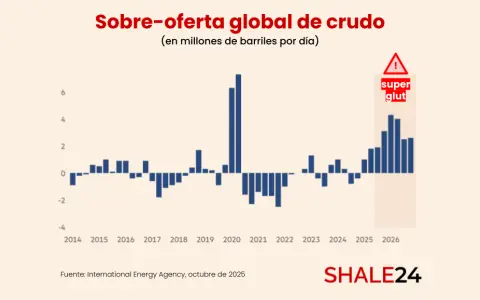
Expectations of a U.S. government reopening push oil prices down
The political context in the United States has implications for oil price dynamics
It will consist of a 207-kilometer (128-mile) parallel pipeline and will increase transport capacity by an additional 220,000 barrels per day.
Pluspetrol moves forward with its expansion roadmap, targeting production of about 100,000 barrels per day by 2027. The company aims to accelerate output.
A specialized report highlights the sector's potential and emphasizes that its activity depends not on temporary incentives, but on operational maturation. It also notes the impact on import reduction and the development of related sectors.
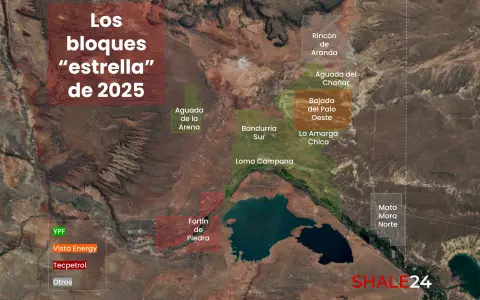
The company is accelerating its role in the shale oil boom, driven by increased efficiency in wells in Bajada del Palo Oeste and La Amarga Chica.
Notable names include CGC (Compañía General de Combustibles), which already has a presence in the region, and Selva María Oil, a national operator that has been growing in smaller-scale projects.
With its sights set on 2027, YPF will seek to integrate Middle Eastern oil companies. The first would be ADNOC, and Saudi Aramco is also expected.
A syndicated loan with banks in the Americas, the US, and Asia supports operations in Vaca Muerta and strengthens the oil company's position in a context of recovering prices.
The governors of Chubut and Santa Cruz are leading talks with national officials to seek tax incentives that would revive the oil industry and create jobs in regions hit by declining production
The oil company seeks to optimize fuel supply logistics in northern Argentina
The forecast underscores a shift from exploratory pads to full-scale development, where multi-well pads are becoming the norm to slash drilling costs and boost returns
With only 7% of its reserves explored to date, the field has driven a production boom that in 2025 represents nearly 60% of the national crude oil extraction