
Energy Policy


The United States is in talks to finance Argentine energy, mining and infrastructure projects beyond its $7 billion export-credit framework, a State Department official said.
Katrien Hinderdael, director and acting coordinator of the State Department's Partnership for Global Infrastructure and Investment (PGII), said on Thursday that Washington was already discussing amounts above that framework, under which the U.S. Export-Import Bank (EXIM) agreed in September to mobilize up to $7 billion through 2027. She did not announce a new committed figure.
She spoke at the International Seminar: Lithium in South America in Jujuy province, an annual industry conference organized by trade publication Panorama Minero. Her comments matter because U.S. development and export-credit agencies are becoming a key source of long-term capital for Argentine projects at a time when higher global borrowing costs have pushed local companies out of international debt markets.
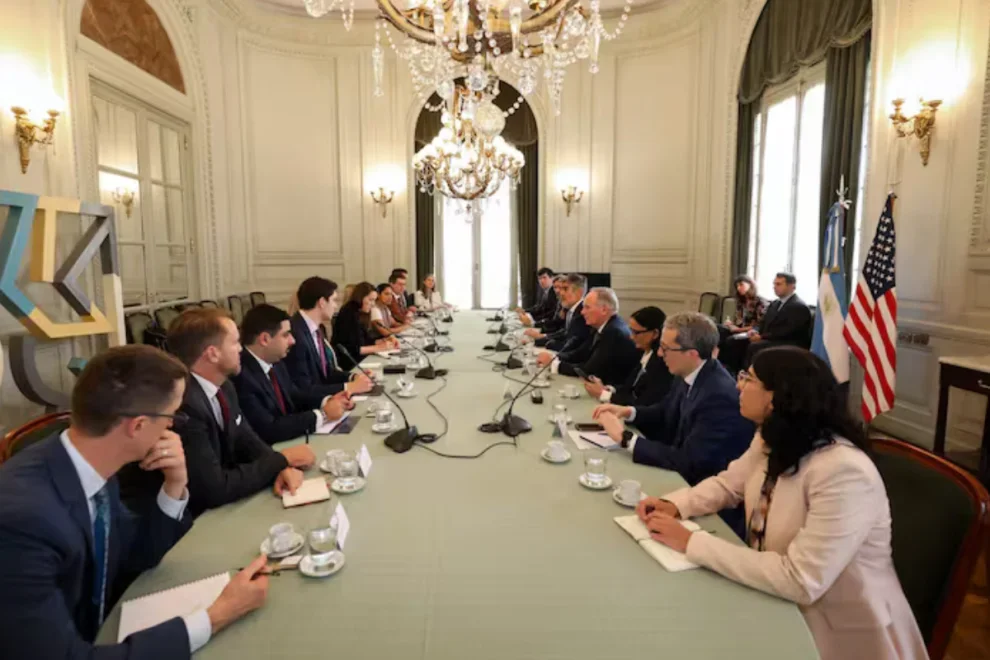
Hinderdael led a joint mission of the State Department, the U.S. International Development Finance Corporation (DFC) and EXIM that visited Buenos Aires, Salta and Jujuy. In Buenos Aires, the delegation met Diego Chaher, Argentina's Secretary for the Transformation of State-Owned Enterprises, to discuss Belgrano Cargas, the state-owned freight railway, and the planned sale of three thermal power plants. It also met U.S. Ambassador Peter Lamelas and Fernando Brun, Argentina's Secretary of International Economic Relations.

DFC Weighs Some 20 Argentine Projects
According to Argentine daily La Nación, the DFC has about 20 projects under evaluation in Argentina. They include a corporate loan to Vista Energy Argentina, the local unit of Vista Energy, an independent Vaca Muerta-focused producer, and talks with Pampa Energía, a diversified Argentine energy company and co-controlling shareholder of Transportadora de Gas del Sur (TGS), Argentina's main southern gas pipeline operator.
The talks concern TGS's natural gas liquids (NGL) project, designed to process components of Vaca Muerta gas and export them from Bahia Blanca, Argentina's main industrial port and petrochemical hub. Vaca Muerta, in Argentina's Neuquen Basin, is one of the world's largest shale plays.
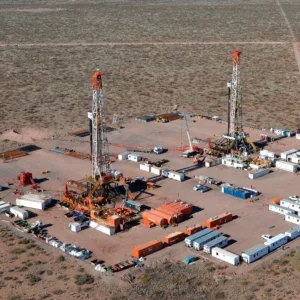
The DFC plans a loan to support Vista's activities in Vaca Muerta, covering drilling rig leases, new wells and completion services. The funds would support the company's general operations rather than a specific development. The documents disclose no amount or tenor and show no final approval.
What Each U.S. Agency Can Offer
Hinderdael said EXIM seeks to back U.S. suppliers of equipment and technology, including in mining. She also outlined a route to finance projects without a U.S. company selling them goods or services: EXIM's Supply Chain Resiliency Initiative, which requires supply contracts with buyers in the United States.
As an example, she cited lithium sales to a U.S. processing plant. The initiative excludes projects controlled by Chinese entities or dependent on Chinese technology. The DFC has more flexibility, she said, and can offer loans, equity, political risk insurance and some project development support.
She added one condition. A U.S. company need not take part, Hinderdael said, but projects must align with Washington's broader strategic interests and with those of the partner country receiving the investment.
She also raised the option of bringing in the Pentagon's Office of Strategic Capital (the Trump administration has renamed the Department of Defense the Department of War). The office has up to $100 billion in lending authority for critical mineral supply chains, a global allocation with nothing earmarked for Argentina.
Hinderdael said the office could invest directly in strategic projects that require significant capital. She also offered grant funding for feasibility studies and environmental assessments, plus technical support to plan power infrastructure and evaluate mining projects.
Argentina LNG Anchors the Andes-Atlantic Corridor
The mission falls under the Andes-Atlantic Corridor, which the U.S. and Argentine governments formalized in New York on Sept. 23. Washington presents it as the first PGII corridor in the Western Hemisphere. It aims to modernize the rail, pipeline, port, power transmission and digital networks linking Vaca Muerta and Argentina's mineral-rich northwest with river and Atlantic ports.
The largest project is Argentina LNG, led by YPF, Argentina's state-controlled oil and gas company, with Eni, the Italian energy company, and XRG, ADNOC's international investment arm. Washington values it at about $51 billion. EXIM has issued a non-binding indicative term sheet for up to $6 billion to finance U.S. goods and services, subject to final approval by its board and to the project's final investment decision (FID).
That figure equals about 86% of the $7 billion framework, which is set out in the U.S.-Argentina Build the Future Framework that EXIM signed with the Argentine government.
The State Department document also identifies McDermott, the U.S. engineering company, as the contractor awarded the gas fractionation and treatment plant. It names Pumpco, a MasTec subsidiary, which together with Italy's Bonatti and Argentina's Contreras Hnos. won an engineering, procurement and construction (EPC) contract worth more than $1 billion for the export pipeline system, also subject to FID.
Higher Rates Raise the Cost of Credit
The push comes as international credit grows more expensive. Yields on 10-year U.S. Treasuries have climbed to around 5%, a level last seen in 2023, prompting Argentine companies to postpone international bond issues. Consultancy Grit Capital said in its latest report that as long as those rates stay high, any recovery in Argentine bonds could be capped even on positive news, and it pointed to the DFC as a channel for large-scale, long-term investment.
So far, the only concrete figure is EXIM's non-binding term sheet of up to $6 billion for Argentina LNG. No amounts or final approvals have been disclosed for the other projects.