Pluspetrol $12 Billion RIGI at Bajo del Choique–La Invernada
The 600-well, 25-year development at the former ExxonMobil block is now the largest upstream commitment filed under Argentina's investment incentive regime.
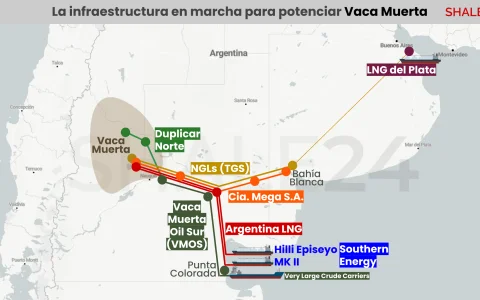
From floating LNG to crude export pipelines and NGL fractionation, a concurrent buildout across Vaca Muerta's full value chain represents the largest private investment cycle in Argentina's energy sector this century
With Neuquén crude output at 600,000 bbl/d and the Duplicar Plus system approaching saturation, Argentina's two main midstream operators are racing to build crude, gas, and NGL evacuation infrastructure — and manage the capacity gap in between
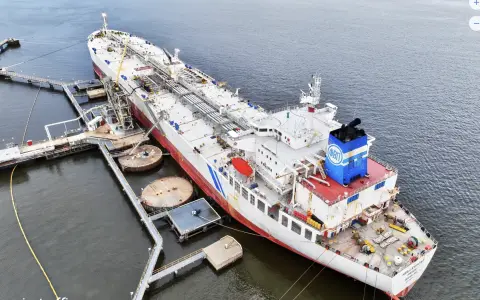
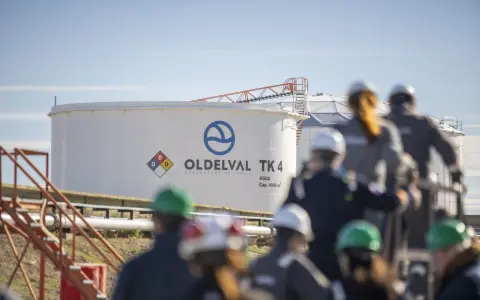
The loading and export of crude from Neuquén Basin operators to the United States was carried out more efficiently and quickly thanks to newly inaugurated infrastructure built in partnership with Oldelval.
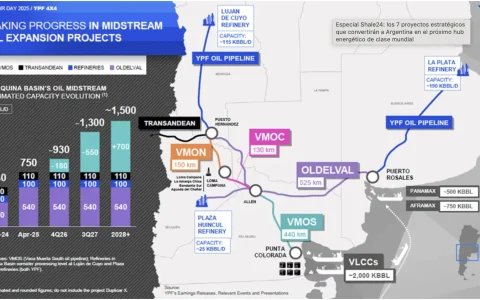
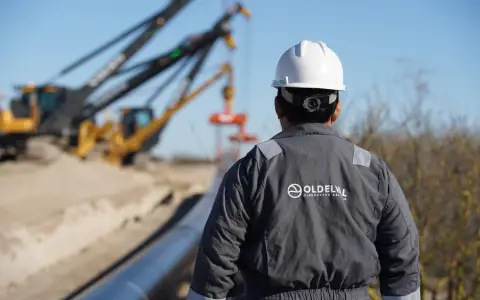
The pipeline will be 209 km long, linking the northern area of the Neuquén Basin with the pumping station in Allen, Río Negro. The project will expand the transport system’s capacity from 20,400 to 55,400 cubic meters per day and will connect to the Vaca Muerta Oil Sur (VMOS) system.
The key operator of Argentina’s main crude oil transport system has taken a strategic step to strengthen its financing amid high demand for evacuation capacity in Vaca Muerta.
Oldelval expects early start-up by the end of 2026. In its first phase, the pipeline will transport 220,000 barrels per day, expandable to 300,000 and eventually 500,000.
Vaca Muerta is now the world’s second-most productive shale formation, trailing only the Permian Basin in the United States. Here are the numbers, drivers and projections behind a level of growth Argentina has never seen before.
It will consist of a 207-kilometer (128-mile) parallel pipeline and will increase transport capacity by an additional 220,000 barrels per day.