Analysis: Vaca Muerta and a 2025 Review
By Ariel Kogan, Oil and Gas Economics Analyst
The CEO and President of YPF set out three ambitious goals for 2026 while highlighting the progress achieved so far, with energy focused on boosting operational efficiency and reducing costs.
Its arrival underscores operators’ push for cutting-edge technology in Latin America’s leading shale formation.
While U.S. shale basins face the maturity of oil fields that once seemed endless, the opposite is unfolding in Argentina’s Patagonia: Vaca Muerta is just getting started, and its momentum is already making allies and rivals take notice.
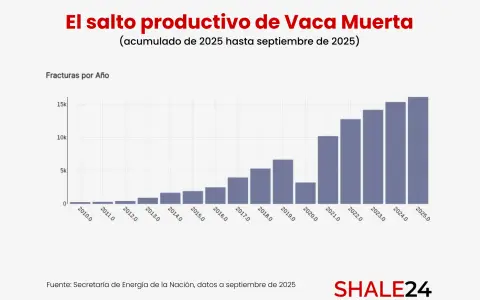
Vaca Muerta is now the world’s second-most productive shale formation, trailing only the Permian Basin in the United States. Here are the numbers, drivers and projections behind a level of growth Argentina has never seen before.
The project involves a 480-kilometer pipeline that will supply Southern Energy’s Argentina LNG project. This key infrastructure for energy exports is set to finalize its development plan in December. Both TGN and TGS have expressed interest in participating in the project.
A critical piece of equipment has lowered costs, sped up operations and reduced risks in Vaca Muerta, one of the most challenging geological formations in the world.
The oil company set a record in its shale oil production and has logged more than 80% growth in two years
During Vista Energy’s recent Investor Day, where Miguel Galuccio, the company’s chief executive, laid out a strategic plan that includes a US$4.5 billion investment in Vaca Muerta through 2028, Shale24 secured an exclusive interview to capture his outlook.
The energy company is one of the jewels of the local market, and its returns are very good. The market sees it as a good bet
Vista outlined its five-year growth strategy at the event, targeting output of over 200,000 barrels of oil equivalent per day by 2030
The political context in the United States has implications for oil price dynamics
It will consist of a 207-kilometer (128-mile) parallel pipeline and will increase transport capacity by an additional 220,000 barrels per day.
Pluspetrol moves forward with its expansion roadmap, targeting production of about 100,000 barrels per day by 2027. The company aims to accelerate output.
The energy sector is among the standouts in Argentina’s mergers and acquisitions activity, driven by Vaca Muerta