
Investments of $18 billion

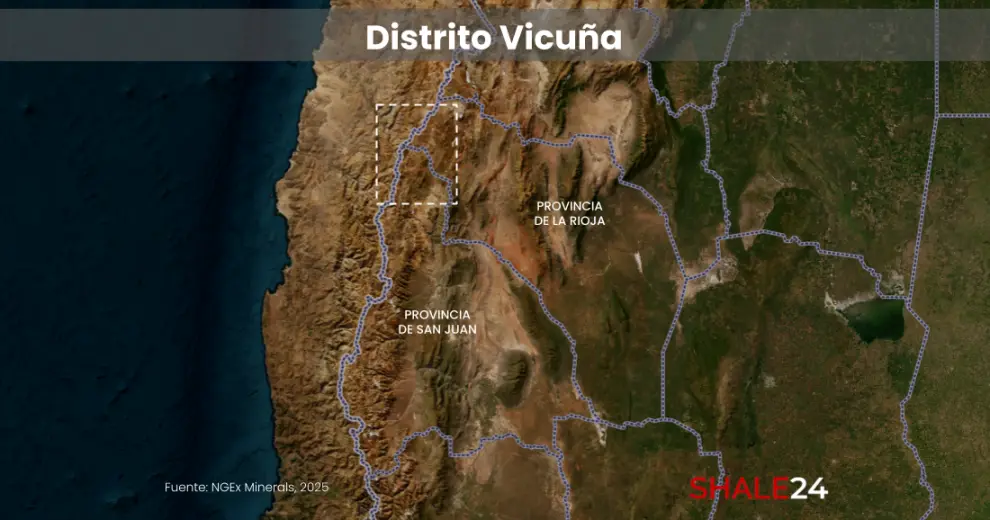
The Vicuña project, an ambitious binational mining district developed by the joint venture Vicuña Corp. (50% BHP and 50% Lundin Mining), took a key step forward yesterday with the presentation of its Preliminary Economic Assessment (PEA) in Toronto during the PDAC convention.
Click here to access the report
The study provides, for the first time, a unified technical view of the Josemaría deposit in San Juan, Argentina, and the Filo del Sol deposit on the Argentina-Chile border, positioning Vicuña among the world’s most significant copper, gold, and silver projects. The PEA outlines a three-stage development plan with conventional open-pit mining and operational synergies designed to optimize costs and production.
According to the study, the project is expected to produce an average of 395,000 tons of copper, 711,000 ounces of gold, and 22.2 million ounces of silver annually during the first 25 years of operation. Production is projected to peak at more than 500,000 tons of copper, 800,000 ounces of gold, and 20 million ounces of silver in later stages.
With an initial mine life exceeding 70 years, total extraction is estimated at 22.3 million tons of copper, 37.2 million ounces of gold, and 763 million ounces of silver. These figures place Vicuña among the five largest mines globally for these metals, with projected revenues of 60% from copper, 32% from gold, and 8% from silver.
Total capital expenditure over the life of the project is estimated at US$18.1 billion, with US$7.1 billion allocated to Stage 1—initially focused on Josemaría sulfides. Stage 1 includes a 175,000‑ton‑per‑day concentrator, with production expected to start in 2030. Sustaining capital (capex) is projected at an additional US$30.3 billion.
The base-case economic analysis shows an after-tax net present value (NPV) of $9.5 billion at an 8% discount rate, an internal rate of return (IRR) of 14.8%, and a payback period of 8.4 years. Operating costs are highly competitive, with a net cash cost of -$0.20 per pound of copper and an all-in sustaining cost (AISC) of $0.47 per pound over the first 25 years.
In Argentina, the project benefits from the Large Investment Incentive Regime (RIGI) as a PEELP, facilitating its development. For 2026, investments of roughly US$790 million are planned as part of a larger commitment, generating 5,500 direct jobs and 19,000 indirect jobs during construction, along with estimated annual fiscal revenues of US$965 million (US$69 billion over the mine’s life).
Project infrastructure includes access roads, power transmission lines, water supply, and tailings management built to international standards.
The PEA presentation marks a significant milestone, positioning the project for a potential final investment decision by year-end, after which construction of Stage 1 would begin. The full NI 43‑101 technical report will be filed on SEDAR+ within 45 days, while optimizations for Stages 2 and 3 continue, along with environmental assessments in Argentina (EIA) and Chile (RCA), and detailed engineering.