
October official data

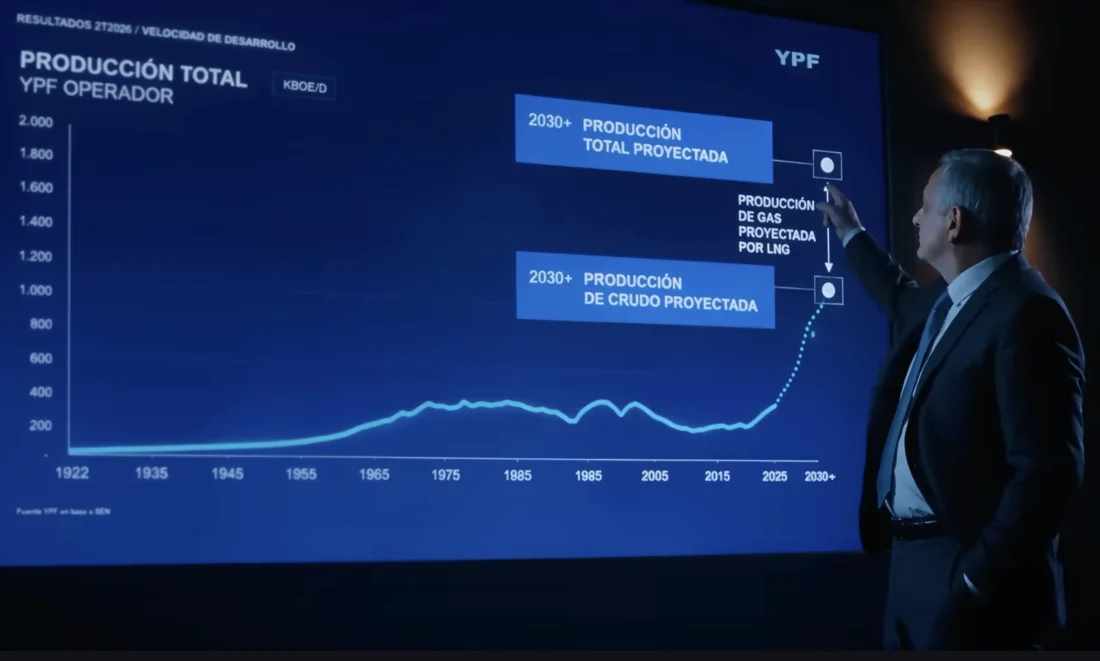
Shale oil production operated by YPF, Argentina's state-controlled oil and gas company, reached 361,215 barrels per day (bbl/d) in October, according to data from Argentina's Secretariat of Energy, up 2.3% from September and 18.4% from a year earlier. The figure tops September's 353,261 bbl/d, which had already been the highest in the company's series. These are gross operated volumes: they include the share that belongs to partners in the blocks the company operates.
For more than a decade, Loma Campana was the yardstick for YPF's shale business. It was the first large-scale development in Vaca Muerta, one of the world's largest shale plays, located in Argentina's Neuquén Basin, and it remains the block that contributes the most crude to the country. The company's growth, however, has started to come from farther south, from a block that less than two years ago was producing about 2,000 bbl/d, according to the company itself.
The underlying story lies in the mix. La Angostura Sur I and La Angostura Sur II together produced 72,635 bbl/d, 13,623 bbl/d more than in September. In the same month, YPF's operated shale oil output grew by about 7,950 bbl/d overall. The two southern blocks therefore added more than the company as a whole, and the rest of the portfolio offset the difference with declines.
La Angostura Sur already produces more than 72,000 bbl/d
La Angostura Sur I reached 62,003 bbl/d, up 21.7% month on month and more than double its October 2025 output. La Angostura Sur II, the smaller of the two, grew 31.9% to 10,632 bbl/d. Together they account for 20.1% of the shale oil YPF operates.
The share is higher when measured against the company's own net production. In April, the company reported that the block already accounted for 25% of its shale oil production, and the difference has a simple explanation: YPF holds 100% of La Angostura Sur, while in the large northern blocks it shares production with partners. The stated goal at the time was to reach 100,000 bbl/d, a target the company placed in early 2027, with the Hub Sur facilities in operation.

The large blocks in the northern part of the formation moved at a different pace. Loma Campana remained the highest-producing block, at 91,831 bbl/d, down 1.1% month on month. La Amarga Chica rose 0.9% to 85,126 bbl/d. Bandurria Sur slipped 4.1% to 77,578 bbl/d after its September peak. Bajo del Toro Norte fell 24.2% to 7,477 bbl/d, although it is 48% above a year earlier, and Aguada del Chañar recovered 5.2% to 16,718 bbl/d.
The changes compare daily averages, and October had one more day than September. With that caveat, the month's momentum came from the south, while the Añelo hub moved around its existing levels.

Malargüe's two blocks keep producing, now under Venoil
Total crude oil production operated by YPF was 386,145 bbl/d, up 0.9% from September and down 2.0% from October 2025. Behind that comparison lies a change in perimeter. The company stopped operating Cerro Fortunoso and Valle del Río Grande, the two concessions in the Malargüe cluster in southern Mendoza province, which in September still appeared in its figures with about 4,050 bbl/d. On a like-for-like basis, excluding those blocks, operated crude grew 2.0% in the month.
The Hydrocarbons Directorate of Mendoza's Ministry of Energy and Environment authorized the transfer of YPF's 100% interest in the two concessions to Venoil, the Mendoza-based operator that has made Malargüe the center of its growth. At the Shale24-Santander Energy Summit, its president, Gustavo Naves, said the company had grown from 7 to 900 employees and is working under a $200 million investment plan over ten years.
For the province, the handover keeps the barrels in Malargüe, in the hands of a local company that buys the fields the majors leave behind to focus on shale. YPF's relationship with Mendoza, meanwhile, is shifting toward unconventional resources: in September, the company's chairman and CEO, Horacio Marín, told Shale24 that YPF will take a drilling rig to Mendoza to drill three wells in the Vaca Muerta "tongue", the formation's extension into the province.

Conventional output operated by YPF fell to 24,930 bbl/d, down 15.6% from September. Excluding the Malargüe blocks from the comparison, the decline was 2.2%. As a result, shale now accounts for 93.5% of the crude operated by the company, compared with 92.3% in September and 77.4% a year earlier.
YPF heads into December with its net production target in sight
Operated and net output are different measures: the 361,215 bbl/d include, for example, the share of Vista Energy, an independent Vaca Muerta-focused producer, in La Amarga Chica. The target YPF committed to investors is measured in net production: 250,000 bbl/d of shale oil at the December exit rate. At the AOG Patagonia event in Neuquén, Marín reported net output of 248,000 bbl/d, and on the third-quarter earnings call he said the company had posted a single day of 252,330 bbl/d and that December's average could be around 255,000 bbl/d.
According to Marín, the Vaca Muerta Oil Sur (VMOS) pipeline will begin filling in January, and exports should start in March. By then, La Angostura Sur is targeting 100,000 bbl/d, and Loma Campana will have company at the top of the table.