
Gas in Transition Interview
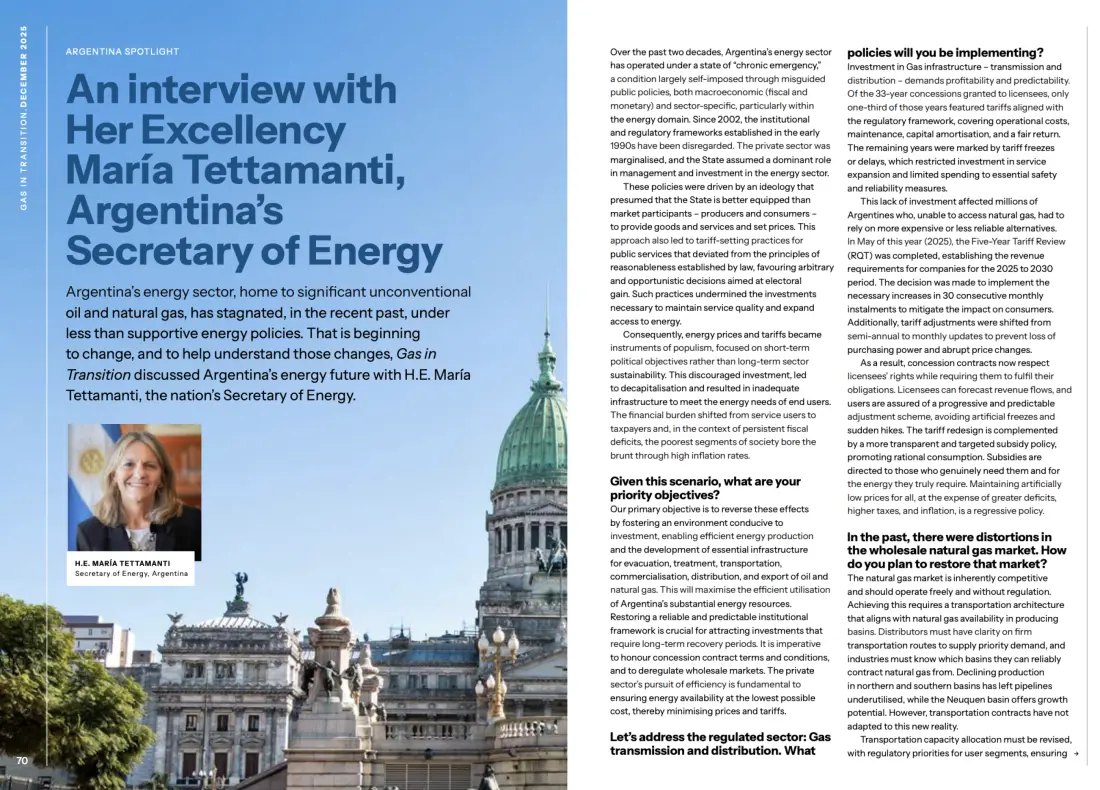
The December 2025 issue of Gas in Transition —the official publication of the International Gas Union (IGU)— dedicated a special section to Argentina, highlighting LNG and natural gas innovation. In the “Argentina Spotlight” segment, Energy Secretary María Tettamanti discussed the sector’s inherited challenges, measures implemented in 2025, and the roadmap for turning Argentina into a structural net gas exporter.
Tettamanti said that since 2002, institutional and regulatory frameworks consolidated in the 1990s were dismantled. She argued that the state assumed a dominant role in investment and management, applied arbitrary tariffs for short-term electoral gains, and caused widespread undercapitalization. The result was insufficient infrastructure to meet domestic demand, record gas imports, and broad subsidies that shifted financial burdens from consumers to taxpayers, directly affecting fiscal deficits and inflation. Lower-income groups were the hardest hit by these regressive policies.

Asked about her priorities, Tettamanti said:
“Our primary objective is to reverse these effects by fostering an environment conducive to investment, enabling efficient energy production and the development of essential infrastructure for evacuation, treatment, transportation, commercialisation, distribution, and export of oil and natural gas. This will maximise the efficient utilisation of Argentina’s substantial energy resources. Restoring a reliable and predictable institutional framework is crucial for attracting investments that require long-term recovery periods. It is imperative to honour concession contract terms and conditions, and to deregulate wholesale markets. The private sector’s pursuit of efficiency is fundamental to ensuring energy availability at the lowest possible cost, thereby minimising prices and tariffs.”
The conversation then turned to regulated transmission and distribution.
Tettamanti explained: “Of the 33-year concessions granted to licensees, only one-third of those years featured tariffs aligned with the regulatory framework, covering operational costs, maintenance, capital amortisation, and a fair return. The remaining years were marked by tariff freezes or delays, which restricted investment in service expansion and limited spending to essential safety and reliability measures. This lack of investment affected millions of Argentines who, unable to access natural gas, had to rely on more expensive or less reliable alternatives.”
When asked about policies for regulated transmission and distribution, she elaborated:
"In May of this year (2025), the Five-Year Tariff Review (RQT) was completed, establishing the revenue requirements for companies for the 2025 to 2030 period. The decision was made to implement the necessary increases in 30 consecutive monthly instalments to mitigate the impact on consumers. Additionally, tariff adjustments were shifted from semi-annual to monthly updates to prevent loss of purchasing power and abrupt price changes. As a result, concession contracts now respect licensees’ rights while requiring them to fulfil their obligations. Licensees can forecast revenue flows, and users are assured of a progressive and predictable adjustment scheme, avoiding artificial freezes and sudden hikes. The tariff redesign is complemented by a more transparent and targeted subsidy policy, promoting rational consumption. Subsidies are directed to those who genuinely need them and for the energy they truly require. Maintaining artificially low prices for all, at the expense of greater deficits, higher taxes, and inflation, is a regressive policy."
Asked how the government plans to restore the wholesale market:
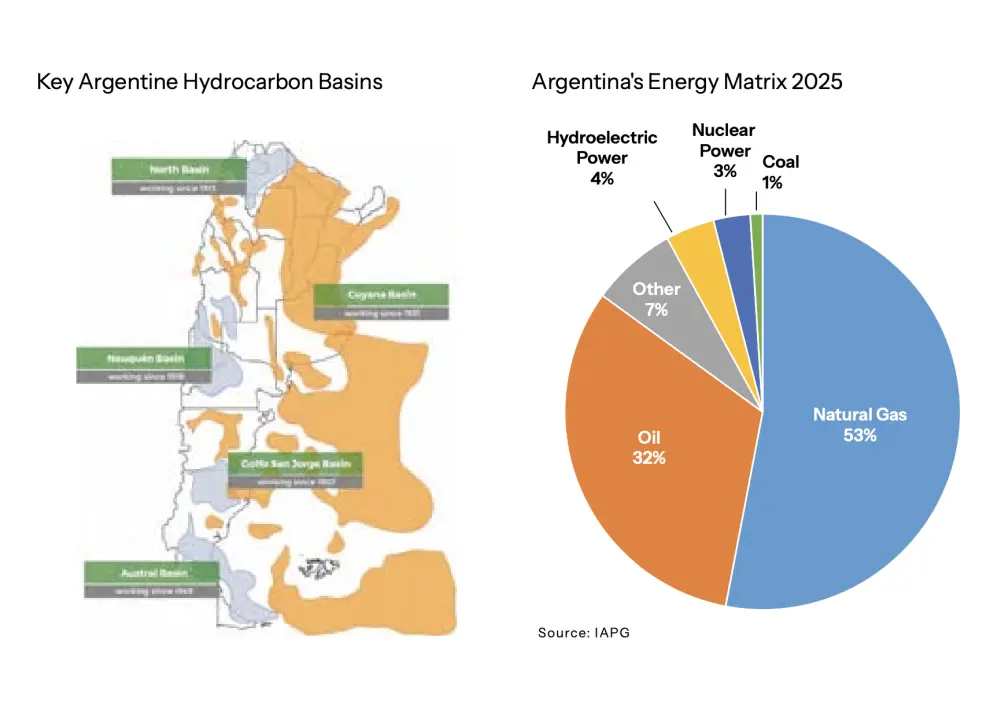
"The natural gas market is inherently competitive and should operate freely and without regulation. Achieving this requires a transportation architecture that aligns with natural gas availability in producing basins. Distributors must have clarity on firm transportation routes to supply priority demand, and industries must know which basins they can reliably contract natural gas from. Declining production in northern and southern basins has left pipelines underutilised, while the Neuquen basin offers growth potential. However, transportation contracts have not adapted to this new reality.
Transportation capacity allocation must be revised, with regulatory priorities for user segments, ensuring each region reflects actual natural gas availability and the need for new firm transportation capacities to support system expansion. Gas transactions should occur between private entities, regardless of end use, and the State should withdraw from commercialisation activities currently managed by Enarsa under the Secretariat of Energy.
For distributor Gas purchases, the passthrough principle for acquisition costs in tariffs must be upheld. This year, Enargas issued a new resolution establishing a transparent methodology for applying this principle, ensuring distributors that neutrality in Gas costs will be maintained. The institutional unification of ENRE and ENARGAS, as mandated by the Ley Bases, is a positive step toward coherent and coordinated regulatory changes, especially in light of technological advances in energy production."
The interview closed with the government’s gas policy outlook:
"The Gas policy we advocate is clear:
-A free, competitive, and orderly wholesale market, enabling producers, transporters, distributors, and industries to enter long-term contracts with costreflective prices, free from unnecessary State intervention.
-A transportation system tailored to evacuation needs, with predictable tariffs that support expansion in response to end-user demand.
- A tariff scheme that adheres to legal principles, avoids opportunism, and incorporates update mechanisms to prevent dilution and abrupt changes.
-Targeted subsidies based on equity and efficiency.
-A State that withdraws from Gas commercialisation and focuses on responsible, intelligent regulation to ensure secure energy supply at the lowest possible cost.
Rebuilding a devastated energy sector is not achievable through a single measure or in a matter of months. It requires consistency, coordination, and above all, political determination to maintain the course: transitioning from chronic emergency to regulatory normalcy; from discretionary practices to clear rules; from pervasive State intervention to a framework that empowers investors and producers.
This is the path we have chosen, and it is the only way to ensure that natural gas – a vital resource for Argentina’s economic competitiveness and quality of life – reaches its full potential," concluded the Energy Secretary.