
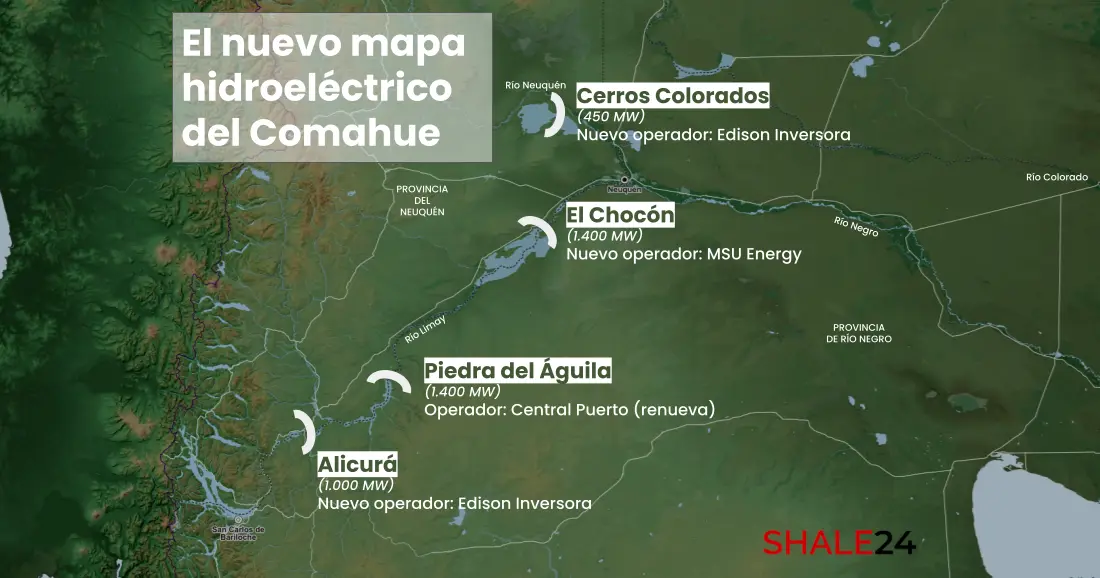
In a move that closes a long cycle, the Argentine government signed the concession and share transfer contracts for the four major hydroelectric dams in the Comahue region: Alicurá, El Chocón-Arroyito, Piedra del Águila and Cerros Colorados.
With this signing, the privatization process enters its final phase, allowing operational control to transition to private hands and generating revenues of US$706.9 million for the national treasury. The ceremony, held in Cipolletti, Río Negro, was attended by Energy Secretary María del Carmen Tettamanti; Undersecretary of Electric Energy Damián Sanfilippo; and the governors of Neuquén, Rolando Figueroa, and Río Negro, Alberto Weretilneck.

Alongside them, representatives of the awarded companies signed the documents sealing 30 more years of private concession. The adjudications, resulting from a public bidding process with broad participation (eight companies competing), were distributed as follows:
- Piedra del Águila (1,440 MW): Central Puerto S.A., with a bid of US$245 million. The local company renews its role as operator of one of the country’s largest plants.
- El Chocón-Arroyito (1,418 MW): Consortium led by BML Inversora S.A.U. and MSU Green Energy (owned by businessman Manuel Santos Uribelarrea), for US$235.7 million. The group has previously invested in distribution and generation in other provinces.
- Alicurá (1,050 MW): Edison Inversiones S.A.U. and the Consortium of Mendoza Companies for Potrerillos, for US$162 million.
- Cerros Colorados (472 MW): Same Edison group, for US$64.2 million (after a bid improvement process).
These figures exceeded initial expectations and reflect private-sector interest in strategic assets that represent roughly 10-15% of Argentina’s power matrix. The dams, built with public investment and privatized in the 1990s, had been operated until now by AES, Enel, Aconcagua and Central Puerto.
The Energy Secretariat emphasized that the process was conducted with full transparency, clear rules, and legal certainty, attracting competitive offers while rejecting those deemed “non-serious.” Operational transition begins immediately: the new concessionaires must meet strict investment, maintenance, and modernization commitments.
This includes mandatory works to ensure dam safety and the sustainability of water resources within a regulatory framework that promotes predictability and efficiency. For the Patagonian provinces, the agreement is a win: it incorporates a water usage fee, a higher share of freely available energy (increasing royalties), and specific funds for water infrastructure projects.
Governors Figueroa and Weretilneck celebrated the northern Patagonian unity that helped protect regional resources.
In short, the operation not only injects more than US$700 million into the treasury at a critical moment for fiscal consolidation, but also moves toward a more modern and efficient management model for an emblematic hydroelectric complex. After decades of uncertainty, the Comahue region enters a new era: less state operation, more private investment, and strict regulatory oversight—a step that will undoubtedly impact Argentina’s energy matrix and public finances.