
World Economic Forum

The administration of President Javier Milei marks a turning point in Argentina’s economic narrative of recent decades, shifting the focus away from state-led welfare policies toward a more aggressive free-market framework.
Milei presented this agenda on the global stage at the World Economic Forum in Davos, where his speeches to political and business leaders underscored deregulation, private capital and a reduced role for the state. The messaging aligned Argentina’s economic reset with market-oriented policies associated with the Trump era in the United States, framing the country as a pro-investment jurisdiction for energy and mining.
Operating under the premise that the country holds world-class resources constrained by an outdated institutional framework, the government has rolled out a multidimensional strategy to turn energy, mining and hydrocarbons into the new growth engines of an Argentina that aspires to global power status.
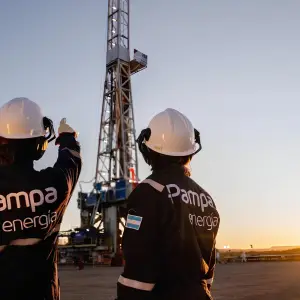
This transformation is being driven through three main pillars: legal safeguards for the RIGI investment regime, a roadmap for privatizations, and the liberalization of prices toward international parity.
RIGI: A magnet for large-scale investment
The Incentive Regime for Large Investments, known by its Spanish acronym RIGI, is not viewed by the Casa Rosada as a simple tax benefit, but as an indispensable condition for restoring international investor confidence. For projects such as floating liquefied natural gas plants in Punta Colorada or copper mines in the Andes, which require upfront investments exceeding $200 million, stability is the most valuable asset.
RIGI guarantees a 30-year framework of legal certainty that includes tax stability, a gradual reduction of the corporate income tax to 25%, and, most critically, unrestricted access to foreign currency and exemptions from export duties.

From an investment marketing perspective, RIGI has allowed Argentina to compete on equal footing with traditionally more stable jurisdictions such as Australia or Chile.
In this context, Milei’s vision is clear: the state alone does not have the capital needed to drill Vaca Muerta or extract copper in San Juan province. Its role should therefore be limited to providing the confidence framework required for capital to flow in and convert Argentina’s geological potential into concrete productive projects.
This legal “shield” has enabled companies such as Italy’s Eni, Continental Resources, SEFE, Golar, Harbour Energy, ADNOC and major global mining firms to revive investment plans, projecting capital inflows that across all projects could exceed $33 billion over the next decade, reshaping the country’s credit profile.
Privatizations: Toward efficiency-driven management
The second pillar of the Milei administration, which underpins the government’s narrative, is the conviction that efficiency is incompatible with direct state control in strategic sectors. The privatization agenda in key industries aims to dismantle what the government describes as a poorly managed, politically driven state-enterprise structure and replace it with entities governed solely by profitability and shareholder value creation.
Milei’s approach to privatization goes beyond outright asset sales and includes concessions of critical infrastructure. The government’s vision is for the private sector to assume both the risk and execution of projects such as the Vaca Muerta South Gas Pipeline, known as VMOS, or the expansion of high-voltage power transmission networks.
By removing the state from operational decision-making, the government seeks to eliminate the political bottleneck that has historically hindered the expansion of sectors critical to Argentina’s productive development. Under this new paradigm, private profitability becomes the measure of public success, ensuring that every dollar invested generates a measurable return in terms of output and what the administration calls “genuine” employment.
Market prices and targeted subsidies
For Milei, energy subsidies were not only a fiscal burden but also a distorted price signal that undermined investment capacity. As a result, another core pillar of his energy policy is full convergence toward international prices, or export parity.
The elimination of cross-subsidies and the adjustment of tariffs to reflect the real cost of generation and extraction are intended to restore the financial health of the energy sector.
Under this model, consumers pay what the resource is worth on the global market, encouraging conservation and, crucially, ensuring that companies generate the cash flow needed to reinvest in additional infrastructure to expand the network.
Through this policy of price “normalization,” the government argues that the true social benefit is not artificially low tariffs that lead to power outages and gas shortages, but a robust energy system capable of exporting large surpluses, strengthening Central Bank reserves and eventually allowing for tax cuts through sustained fiscal surpluses.
It represents a shift from a subsidized economy of scarcity to one of competitive abundance.