
Siemens Energy and Pan American Energy


In the Austral Basin, TotalEnergies, through its operator Total Austral, has implemented a globally significant technical advance in the integration of renewable energy into hydrocarbon Exploration and Production (E&P) operations: the world’s first hybrid solution combining wind generation with electrochemical storage to electrify gas and condensate treatment facilities that are isolated from the interconnected power grid.
The system entered commercial operation on Jan. 30 at the onshore Río Cullen and Cañadón Alfa plants, located on the northern coast of Tierra del Fuego, Argentina’s southernmost province.
These facilities process production from multiple offshore fields within the Cuenca Marina Austral concession — operated by Total Austral (37.5%), alongside Harbour Energy (37.5%) and Pan American Energy (25%) — including Fénix, Carina, Aries and Vega Pléyade, among others. Gas is transported via subsea pipelines to the treatment plants. Eduarda Philadelpho Fernandes de Pina, a CCA-certified board member and TotalEnergies’ Asset Director for Tierra del Fuego, provided details in a company publication.
Project overview: A new global standard
The project’s hybrid configuration includes:
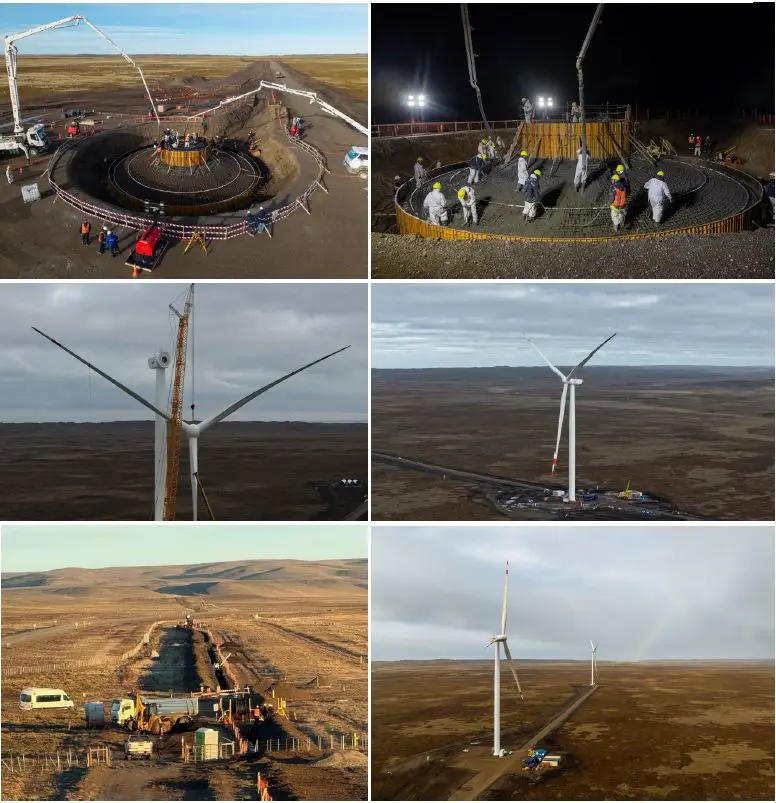
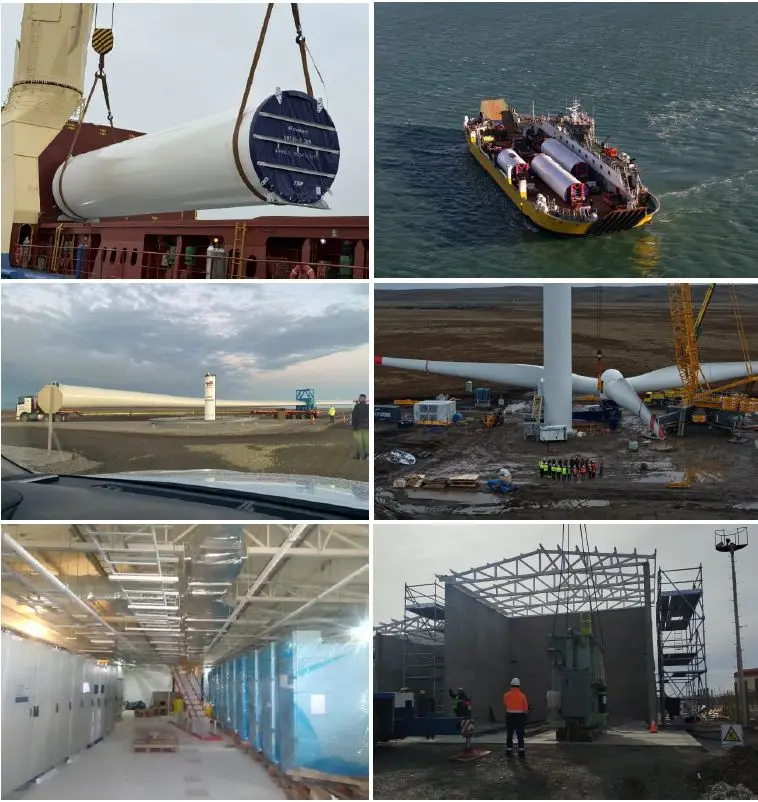
Two Goldwind wind turbines (model GW136-4.2 MW or an adapted equivalent), with total installed capacity of 8.4 MW. They are the southernmost turbines on the planet outside Antarctica, installed at a site with exceptional wind resources characterized by high and persistent average speeds. The turbines feature an 86-meter hub height and a 136-meter rotor diameter, optimized for extreme cold, icing and strong winds.
A lithium-ion battery bank supplied by Saft (a TotalEnergies subsidiary), with an energy capacity of 9.2 MWh. The system operates as a short-term buffer, absorbing wind variability, delivering rapid ramp power and ensuring continuity for critical loads during periods without wind or during demand spikes.
An Energy Management System (EMS) provided by Siemens Energy, acting as the intelligent core of the hybrid scheme. In real time, the EMS performs:
- Monitoring and data acquisition across all assets: wind generation, battery state of charge, process plant demand and gas-fired backup generation.
- Optimization of energy dispatch through predictive control algorithms, prioritizing renewable energy and minimizing the use of gas turbogenerators.
- Dynamic balancing of power and frequency, transient management, partial black-start capability, ride-through during wind faults and control of power flow on the internal medium-voltage bus.
- Remote supervision and industrial cybersecurity integrated with existing SCADA systems, enabling unified operations and reducing fuel gas self-consumption.
Project impacts
According to the operator, the project’s environmental and operational impact includes:
- A 56% reduction in direct emissions associated with on-site power generation.
- A projected cumulative avoidance of 635 ktCO₂eq through the end of the Austral Basin concession.
- The release of additional natural gas volumes for the domestic market by reducing fuel gas used for self-consumption.
With this development, Río Cullen and Cañadón Alfa become the first TotalEnergies E&P site worldwide to operate under a renewable-storage hybrid scheme of this scale. The project aligns with the company’s strategy to reduce upstream carbon intensity by integrating local renewables into remote, energy-intensive assets and leveraging Patagonia’s wind resources to decarbonize mature operations.
Execution required technical coordination between teams in Buenos Aires and Tierra del Fuego, with a strong component of local labor during construction and commissioning.
Renewable portfolio in Argentina
The project forms part of the renewable energy portfolio TotalEnergies is developing in Argentina, where the company currently operates five plants with installed capacity approaching 300 MW and annual production of roughly 1,110 GWh. The portfolio includes:
- Mario Cebreiro Wind Farm (100 MW, Buenos Aires province).
- Vientos Los Hércules Wind Farm (97.2 MW, Santa Cruz).
- Malaspina Wind Farm (50 MW, Chubut).
- Caldenes del Oeste solar photovoltaic plant (30 MWp, San Luis).
- Amanecer solar photovoltaic plant (13.6 MWp, Catamarca).
The company is also advancing green hydrogen projects and a pipeline exceeding 1,000 MW in additional capacity. These assets reinforce TotalEnergies’ position as Argentina’s leading private gas producer — accounting for about 25% of national output — and highlight its push toward a more diversified, lower-carbon energy mix.
In the context of the energy transition, as hydrocarbon operators seek to electrify isolated facilities to reduce Scope 1 and 2 emissions, this project at Argentina’s southern tip is emerging as a technical and economic benchmark for Patagonian basins and similar environments with strong wind potential and no access to grid power.