
More wind and solar power to come
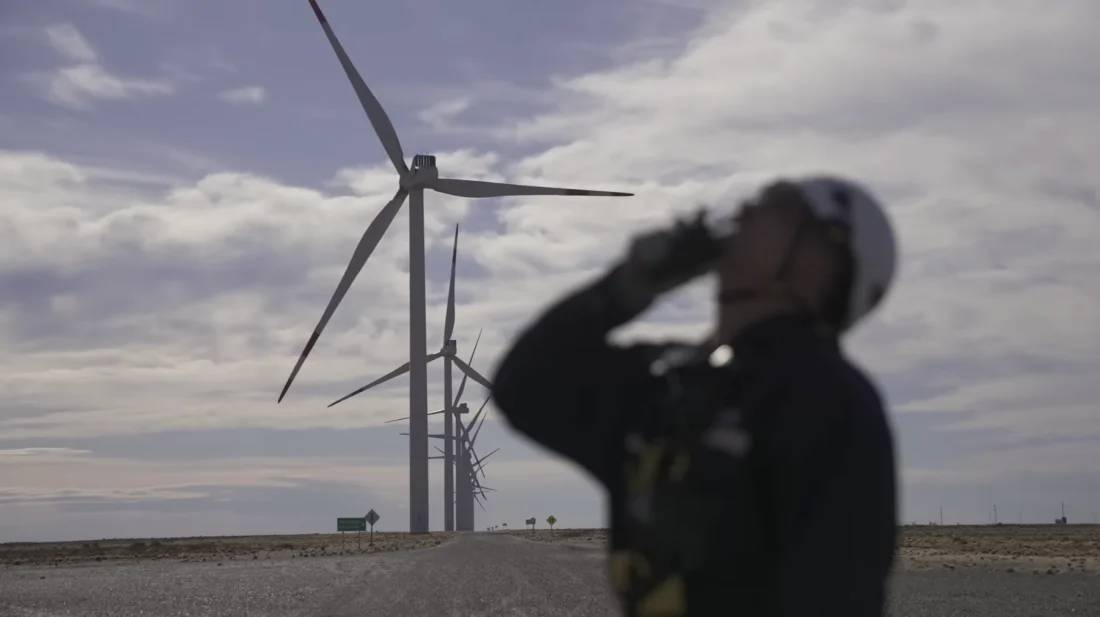
Argentina's wholesale electricity market (MEM — Mercado Eléctrico Mayorista, the country's deregulated power spot market) closed the first 2 months of 2026 with wind generation up 7.9% year-over-year.
The sector recorded 3,049.5 GWh between January and February, according to data from CAMMESA, the Argentine wholesale electricity market administrator — up from 2,826.0 GWh in the same period of 2025.
January was the strongest month: 1,595.2 GWh, a 9.9% increase on the prior year and above the 2025 monthly average of 1,552 GWh. February closed at 1,454.3 GWh, also up year-over-year (+5.8%), though marginally below that average.
Can 2026 Break the Annual Record?
The first 2 months set up a question the sector will track month by month. In 2025, annual wind generation reached 18,628 GWh — the highest on record. At the bimonthly pace of 1,524.8 GWh per month, the 2026 projection would reach approximately 18,297 GWh: 1.8% below the record.
To surpass it, the system must sustain an average of at least 1,548 GWh per month through December. The May–August window is critical: Patagonian capacity factors historically average 48% during those months. The next 90 days will determine whether 2026 can become another record year.
PCR and Genneia Lead the Production Ranking
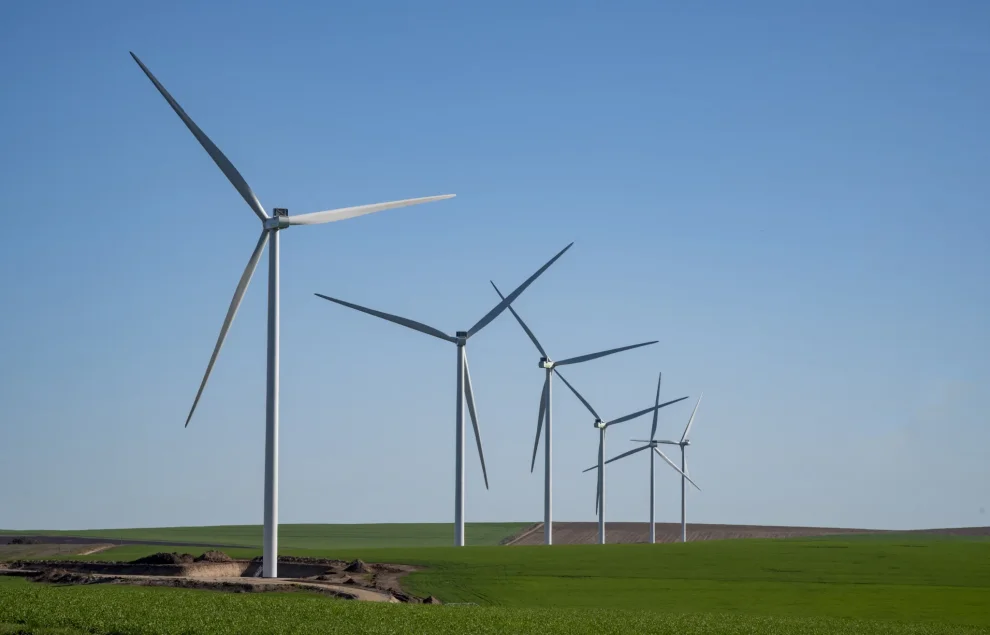
The highest-performing farm in January–February 2026 was the Mataco 3 Picos Wind Park, with 152.0 GWh, owned by Petroquímica Comodoro Rivadavia (PCR), one of Argentina's largest wind energy operators with nearly 550 MW of installed capacity across 6 farms in the provinces of Santa Cruz, Buenos Aires, Cordoba, and San Luis.
Across all its assets, PCR closed the period with a combined 509.5 GWh — approximately 16.7% of all wind generation in the system. The company was founded in 1921 in Comodoro Rivadavia; its CEO, Martín Brandi, chairs the Argentine Wind Energy Chamber (CEA).
PCR's expansion extends well beyond its existing farms. The company is constructing the 180 MW Olavarría Wind Park in Buenos Aires province under Argentina's Large Investment Incentive Regime (RIGI), with an investment of $275 million and a target commissioning date of December 2026.
In March 2026, it secured a $110 million financing agreement with the International Finance Corporation (IFC), the private sector arm of the World Bank Group, for GEAR I — the special purpose vehicle in which PCR holds a 51% stake and ArcelorMittal Acindar, the Argentine steelmaker, holds 49%.
The project includes transmission upgrades at the Olavarría and Ezeiza substations to expand the 500 kV corridor linking that zone to the Buenos Aires metropolitan area load center, which would unlock an additional 260 MW of projects already holding dispatch priority. It is the first private initiative in Argentina to finance integrated transmission infrastructure as part of a renewable energy project.
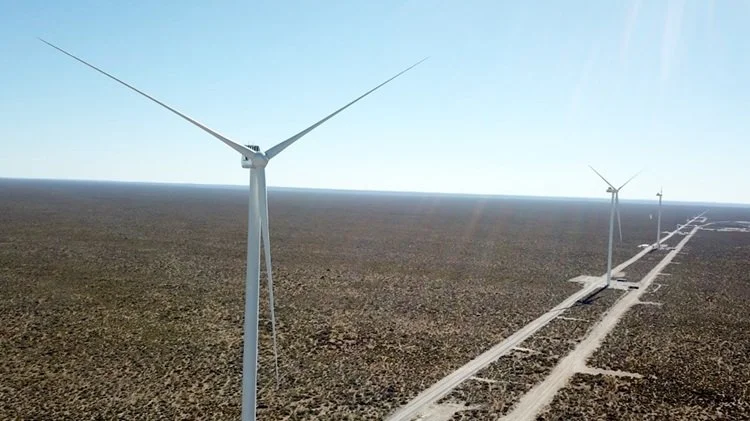
In second place, the ALUAR self-generation wind park in Puerto Madryn, Chubut province — a captive facility serving ALUAR, Argentina's only primary aluminum producer — contributed 127.2 GWh, followed by Puerto Madryn II at 102.8 GWh, both in the Patagonian region.
Puerto Madryn II is operated by Genneia, Argentina's leading renewable energy company with more than 1,100 MW of installed wind capacity. Genneia also contributed La Elbita in Tandil (96.0 GWh), La Castellana, Buena Ventura, Pomona I, and other assets, keeping it as the largest operator in the segment.
Pampa Energía, a diversified Argentine energy company, ranked fifth with its Pampa Energía 6 park in Buenos Aires province at 94.4 GWh (+6.4% year-on-year). YPF Luz, the power generation subsidiary of YPF, Argentina's state-controlled oil and gas company, rounded out the ranking with its Patagonian–Buenos Aires trio: Manantiales Behr in Chubut (75.8 GWh), Los Teros in Azul (74.8 GWh), and Cañadón León in Santa Cruz (72.9 GWh).
Arauco: The Fastest-Growing Operator in the System
The standout growth of the period came not from the largest parks but from a smaller state-linked operator. The Arauco II R1.5 Wind Park Stages 3 and 4 jumped from 25.3 GWh in January–February 2025 to 72.6 GWh in the same period of 2026 — a 187.5% surge reflecting the ramp-up following commercial authorization.
Stage III received commercial authorization on August 2, 2025, when CAMMESA verified the facility met all technical requirements. With a total installed capacity of 99.4 MW, the park's tariff rose from approximately $12/MWh during the testing phase to approximately $80/MWh after authorization.
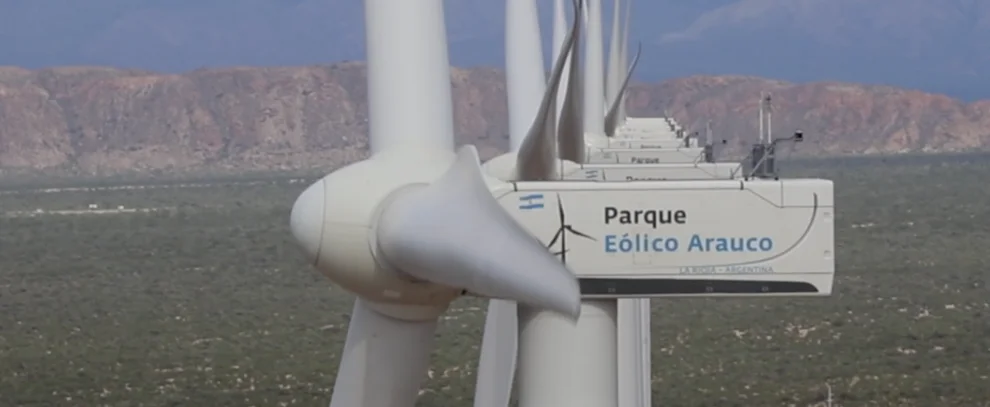
Parque Eólico Arauco is a state-majority-owned company (SAPEM — Sociedad Anónima con Participación Estatal Mayoritaria) whose primary shareholder is the provincial government of La Rioja.
The company operates four wind parks — three owned and one managed for third parties — with 250 MW of installed capacity, and is advancing construction of the Arauco Solar I project to reach 300 MW of hybrid capacity in 2026, which would make it the largest hybrid park in South America.
Stage II of the complex was acquired by Pampa Energía in 2022 for $171 million; that asset, alongside the RenovAr 1.5 Stages 3 and 4, accounts for most of the growth recorded in CAMMESA's system archive.
Two Newcomers and a Transition in Chubut
CAMMESA's archive registers two parks with no prior system history that are already generating in 2026. Vientos La Rinconada Wind Park in Buenos Aires province contributed 63.7 GWh in its first recorded bimonth, entering the top 15 of the system directly. Casa YPF Luz Wind Park, also in Buenos Aires province, added 25.3 GWh on its debut. Both additions brought the total number of active wind plants in the MEM to 71 parks.
Manantiales Behr posted a 7.2% decline — from 81.7 GWh to 75.8 GWh — driven by factors beyond the wind park itself. The facility sits within the conventional Manantiales Behr oilfield, which YPF transferred in February 2026 to Pecom Servicios Energía, the energy services company of the Pérez Companc Group, for $410 million — after the original $575 million deal with Rovella Capital collapsed when the buyer failed to secure the required upfront financing.
The field transfer proceeded amid labor disputes and provincial government challenges. The ownership transition likely explains the lower generation more than any technical grid constraints. YPF Luz has a 20 MW expansion planned for the park, contingent on commissioning a new 500 kV node in the area.
Transmission Infrastructure: The Bottleneck That Won't Yield
The autumn–winter 2026 season will open with a larger wind system than 2025: two new active parks, additional capacity from Arauco, and projects ramping up in Rio Negro and Neuquen.
But pressure on transmission infrastructure — the sector's structural bottleneck — will remain the primary constraint on growth. Without significant expansion of the Patagonia–Buenos Aires and Centro-Cuyo-NOA corridors, a portion of the wind Patagonia can convert into electricity will continue to be curtailed.
From Olavarria, PCR is piloting a concrete answer: financing the 500 kV corridor reinforcement itself as a condition of its RIGI project — a model without precedent in the renewable energy segment. Two processes are converging on the same structural problem in the coming weeks.
On April 14, bids close for the acquisition of a 50% stake in Citelec, the holding company that controls Transener, Argentina's main high-voltage transmission concessionaire: the state is seeking a private operator to take over system-scale management of the high-voltage grid.
At the same time, the Secretariat of Energy has an open tender for 700 MW of battery storage under Resolution SE 50/2026, with bids due May 8. Storage can absorb wind output during high-generation hours and reduce pressure on evacuation lines, but it does not replace the physical capacity needed to move power to Buenos Aires metropolitan area load centers.
Three models are operating on different planes: the generator financing its own grid connection, the private concessionaire taking over the existing network, and the battery operator managing intermittency. Wind generation needs all three.