
The previous absolute peak dated back to 1998

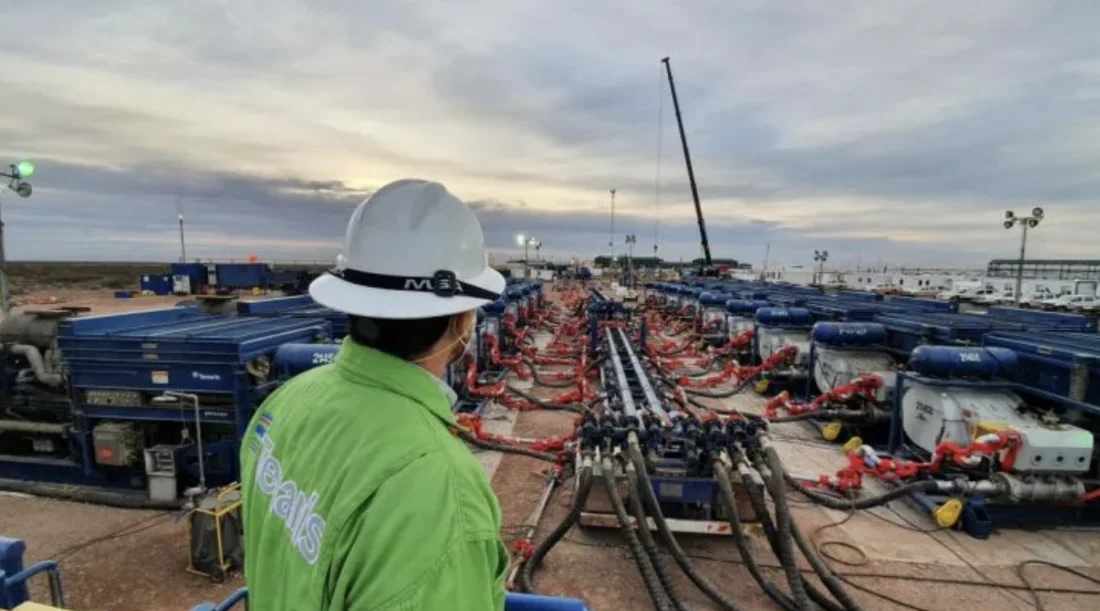
Argentina produced 874,000 bbl/d in February 2026, confirming for the second consecutive month that output has settled above the country's previous all-time record — a mark set in 1998 and unbroken for 27 years.
The February figure, reported by Argentina's Secretariat of Energy, represents a 15.8% year-on-year gain and establishes the current production level as a floor, not a peak.
It is the first time in Argentina's history that two consecutive months have exceeded 870,000 bbl/d. The previous annual average record of 846,900 bbl/d, set in 1998, was first surpassed in October 2025. Since then, output has not fallen back below that threshold.
Neuquén Pulls the Weight; Mature Basins Drag the Average
Neuquén province contributed 603,793 bbl/d in February, equal to 69.1% of national output, according to the provincial Energy Ministry. Within that figure, unconventional production from the Vaca Muerta formation, one of the world's largest shale plays in Argentina's Neuquén Basin, accounted for 96.92% of Neuquén's total, at 585,182 bbl/d. The Neuquén Basin grew 30.36% year-on-year, nearly double the national average pace, illustrating how much the ongoing decline of Argentina's mature basins continues to weigh on the aggregate figure.
Outside Neuquén, the production map tells a different story. The San Jorge Gulf Basin, Argentina's main conventional offshore producing region in Patagonia; the Austral Basin, the country's southernmost producing basin spanning Santa Cruz and Tierra del Fuego provinces; and the Cuyana Basin, the mature conventional oil-producing basin of Mendoza province, are all contracting year-on-year with no local counterweight of comparable scale.
Conventional production is in structural retreat: wells declining under their own depletion curves, investment levels insufficient to reverse the trend, and a national output model that depends increasingly on a single geological district to hold the aggregate figure. The dynamic is familiar to operators in mature North Sea or Gulf of Mexico fields — legacy production declining faster than new development can offset, with a single high-growth asset carrying the national average.
The Gap to One Million, and Why Transport Is the Constraint
Shale24 calculates the remaining distance to the 1 million bbl/d target committed by Horacio Marín, president and CEO of YPF, Argentina's state-controlled oil and gas company, for the course of 2026 at 126,000 bbl/d, roughly the combined daily output of a mid-sized independent E&P.
At the incremental growth rate observed between October 2025 and February 2026, approximately 3,600 bbl/d per month by Shale24's reckoning, Argentina would not reach that figure within the calendar year on a linear trajectory. Hitting one million before December requires an acceleration in the ramp. Vaca Muerta's subsurface can sustain that acceleration; the transport network above it cannot yet guarantee every incremental barrel a route to export markets.

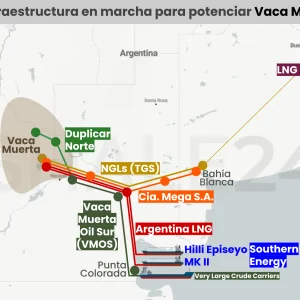
With the Vaca Muerta Oil Sur pipeline (VMOS) still pending commercial startup, evacuation capacity from the Neuquén Basin to the Atlantic remains the most concrete bottleneck in the system. The capacity VMOS will add to the network, 180,000 bbl/d at initial startup scaling to 390,000 bbl/d by mid-2027, would substantially expand the export margin once operational.
Argentina's Atlantic export routes bypass the Strait of Hormuz and the Suez Canal, positioning the country as a supply alternative at a moment when Middle East disruptions have reshuffled global crude trade flows, making the resolution of that transport bottleneck a commercially urgent question, not merely a logistical one.
One million barrels has a symbolic dimension Argentina's industry knows well: it has never reached it. When VMOS enters service and evacuation capacity ceases to be the limiting factor, the conversation shifts. One million would cease to be the target and become the baseline from which the next phase begins.