
"You must be fast"
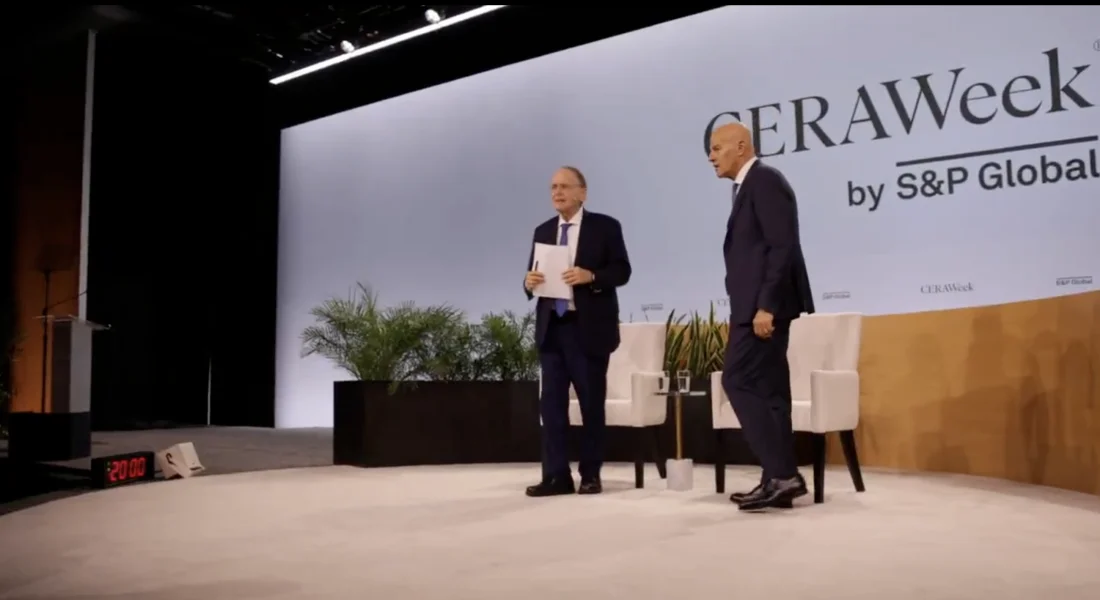
ENI, the Italian energy company, has spent the past 15 years building an exploration success rate of 75–80% by doing the opposite of what the rest of the industry did: keeping exploration capabilities in-house while peers outsourced or cut them under investor and ESG pressure. At CERAWeek, the annual global energy conference organized by S&P Global, CEO Claudio Descalzi laid out the strategic logic behind that bet in a fireside conversation with energy analyst Daniel Yergin — and identified Argentina as one of the markets where the model is being applied with the most urgency.
Descalzi argued that speed of monetization is the only mechanism that can justify exploration risk to shareholders in the current environment. His message at CERAWeek was direct: "You must be fast."
Exploration as Competitive Differentiator
The industry average exploration success rate is roughly 35%. ENI's is 75–80%. Since 2014, the company has discovered more than 12 billion barrels across seven countries spanning Asia, the Middle East, Africa, South America, and northern Europe. In 2025 alone it added approximately 900 million barrels of oil equivalent (boe) in new finds. Of the cumulative total since 2014, 60% has already been converted to production or sold as portfolio assets.
That record runs counter to the consensus that emerged after 2018, when ESG pressure pushed most majors to cut exploration as a signal of financial discipline. Descalzi inverted the argument: well-executed exploration is not a cost to minimize but the most capital-efficient source of value creation available to an upstream company.
The Dual Model: Speed Without Ceding Control
The operational expression of that thesis is what Descalzi described as ENI's dual exploration model. ENI retains operatorship — maintaining technical control — while securing early cash flow through partial sell-downs or joint development structures. The mechanism resolves a longstanding upstream tension: how to monetize a discovery quickly without ceding operational control or becoming dependent on external capital.
The same principle scales to the corporate level through ENI's satellite company model — purpose-built subsidiaries that carry their own capital architecture and self-finance, insulating the parent from consolidated debt and capex. Plenitude, ENI's renewables and retail division, and Azule Energy, ENI and bp's Angola-based upstream joint venture, are the two principal examples. Describing the rationale, Descalzi said the model allowed ENI to "separate activities with different multiples to avoid value destruction." The structure lets ENI invest across multiple platforms without the parent balance sheet absorbing the full liability of each.
ENI's 2026–2030 plan extends that logic: gross capex is targeted below $6 billion per year — roughly $2 billion less than the previous cycle — with net investment of approximately $5 billion annually after portfolio proceeds. For 2026 specifically, capex is projected at $7 billion, an 18% reduction from 2025.
ENI in Argentina: LNG and the South Atlantic
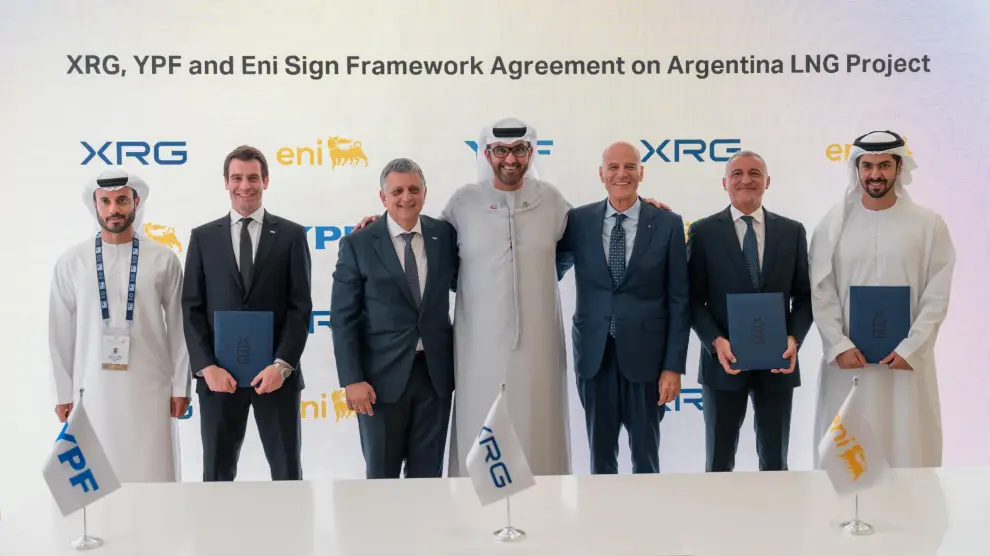
The most visible expression of ENI's Argentina position is the Argentina LNG project — a phased LNG export initiative ENI is developing with YPF, Argentina's state-controlled oil and gas company, and XRG, ADNOC's international investment arm. On February 12, the three partners signed a Joint Development Agreement (JDA), formalizing the start of front-end engineering design (FEED) work on the project.
The scale is considerable: 12 MTPA of liquefaction capacity across two 6-MTPA floating LNG units (FLNGs) to be anchored in the Golfo San Matías in Argentina's Río Negro province — a deepwater gulf suited to loading VLCCs and mooring floating LNG units — with total investment estimated at $20 billion and first exports targeted for 2030 or 2031. That timeline would mark a structural shift for an economy that ran a net energy deficit from 2011 to 2022, spending billions annually on LNG and fuel imports despite holding world-class reserves. YPF is working with JP Morgan on project financing of approximately $15.5 billion — what JP Morgan has described as the largest project finance operation in Latin American history. The FID is now targeted for October 2026, according to YPF CEO Horacio Marín, who provided updated guidance at CERAWeek.
The ENI-YPF partnership extends beyond LNG. In November 2025, the two companies signed an agreement under which ENI acquires a 50% working interest in the OFF-5 offshore block in Uruguayan waters — a 17,000-square-kilometer deepwater block roughly 200 kilometers off the Uruguayan coast at depths of up to 4,100 meters — and assumes operatorship, subject to Uruguayan regulatory approval. The block presents geological similarities to the Orange Basin off Namibia, where ENI's discoveries over the past three years established one of the most significant new deepwater oil provinces identified globally in the past decade — making the comparison materially relevant to how ENI is reading the South Atlantic margin's prospectivity. According to industry sources consulted by Shale24, the operational experience being built in OFF-5 is viewed as a direct precedent for potential activity in Argentine offshore waters.
A Price Environment That Made the Message Urgent
Descalzi spoke against an unusually tense commodity backdrop. Brent crude climbed to approximately $104 per barrel on March 24, recovering from a sharp sell-off the previous session, as energy markets tracked developments in the Middle East conflict and its disruption of tanker traffic through the Strait of Hormuz — the chokepoint through which roughly 20% of global oil supply passes. Argentina LNG's Atlantic export routing carries a specific structural advantage in that context: shipments move via sea lanes that bypass both the Strait of Hormuz and the Suez Canal entirely, making Argentine LNG a supply source insulated from the two maritime chokepoints currently at the center of global energy security concerns. Against that backdrop, Descalzi's remarks on execution speed and energy security read less as long-term strategic vision than as a direct response to the market moment.