
A 48-Inch Line

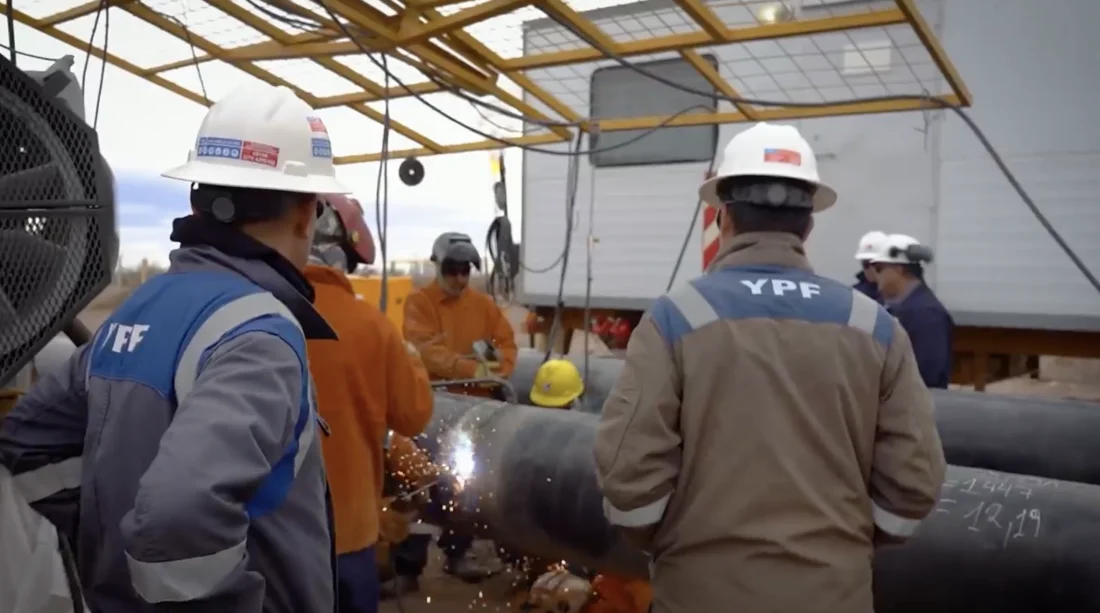
Argentina LNG awarded the civil works for the 527-kilometer trunk pipeline that will carry gas to its planned liquefied natural gas (LNG) export complex.
The project groups YPF, Argentina's state-controlled oil and gas company; ENI, the Italian energy company; and XRG, the international investment arm of ADNOC, Abu Dhabi's state oil company. It notified the winning bidders on July 8.
The roughly $1.2 billion contract went to an international consortium formed by Pumpco, a U.S. pipeline builder and a subsidiary of MasTec; Bonatti, of Italy; and Contreras Hermanos, the local firm that helped design and engineer the route but could not bid because the tender was open only to international companies.
The winning offer came in 15% below the runner-up, a joint venture of Techint, the engineering and construction group, and SACDE, an Argentine builder controlled by Marcelo Mindlin, founder and chairman of Pampa Energía.
The award clears one of the heaviest items on the schedule the consortium must close before its final investment decision (FID), expected in the second half of 2026. In parallel, YPF, ENI, and XRG are preparing the tender for the line pipe over the coming weeks, with an award estimated within two to three months. XRG signed the framework agreement to join YPF and ENI in November 2025 and sealed its entry with a binding joint development agreement in February 2026 that launched basic engineering.
A 48-Inch Line Sized for Neuquén's Entire Gas Output
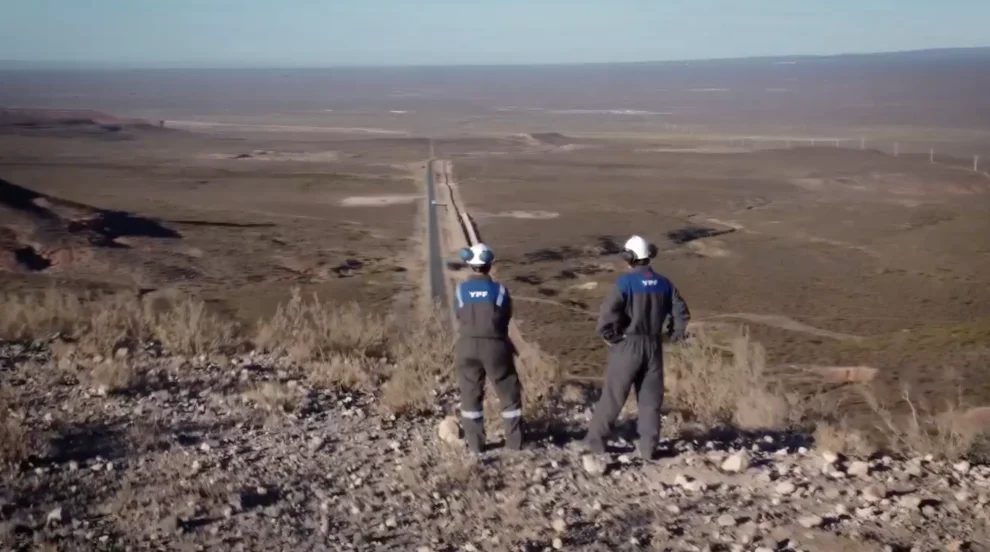
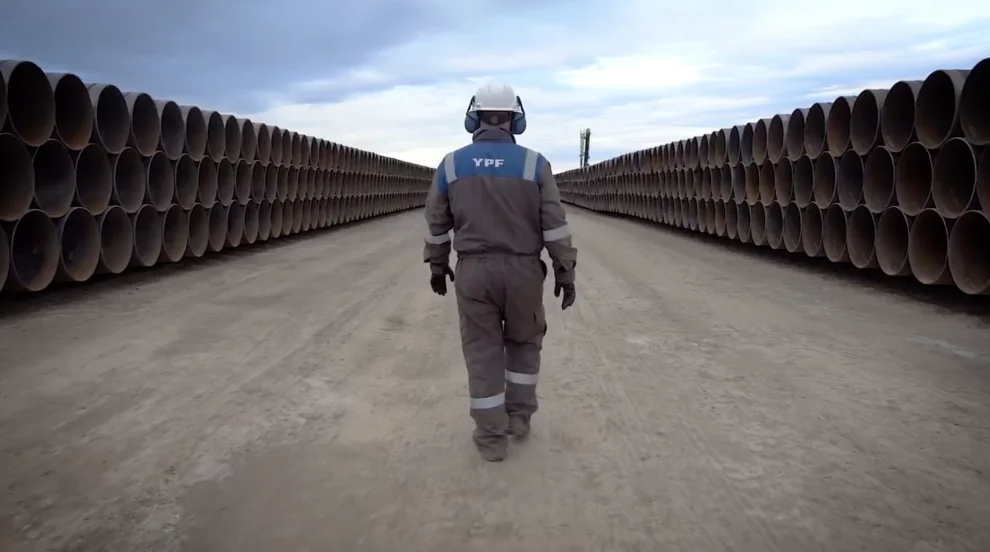
The system starts at the Meseta Buena Esperanza block, west of Vaca Muerta, and runs through the Confluencia department, in Neuquén province, and El Cuy, Avellaneda, and San Antonio, in Río Negro province, before reaching Sierra Grande on the Atlantic coast, where the liquefaction and export terminal will sit. It is built as two parallel 527-kilometer lines: a 48-inch gas pipeline and a 24-inch polyduct for the gas liquids.
At 48 inches, the gas line will be the largest-diameter pipeline built in Argentina, above the 36 inches of the Perito Moreno pipeline (formerly the Néstor Kirchner) and the 36-inch line financed by Southern Energy, the competing Vaca Muerta LNG export venture. It is sized to move between 75 and 100 million cubic meters per day (MMm³/d) of gas, a volume equal to the entire current output of Neuquén province.
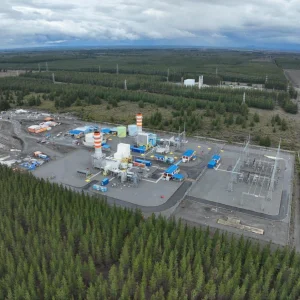
The trunk line begins in the same block where the project recently closed a shareholding reorganization. Meseta Buena Esperanza is one of three areas, alongside Aguada Villanueva and Las Tacanas, in which ENI and XRG agreed to take 32% each and YPF the remaining 36%, through the UPCO ARLNG I vehicle that concentrates the gas blocks assigned to the initiative. The transaction, subject to regulatory approval, defines the productive core that will feed the liquefaction units and anchors the pipeline's head in the block leading that portfolio.
Why Gas and Liquids Travel in Two Separate Lines
The twin-artery design follows the project's processing architecture. The 48-inch line carries gas to the coastal complex, where two floating LNG units (FLNG) of 6 million tonnes per year each form a first phase of 12 million tonnes per annum (MTPA), expandable to 18 MTPA by 2030. The 24-inch polyduct moves the natural gas liquids (NGLs) and condensates in parallel for processing on the coast.
A first separation takes place in Neuquén, at a plant whose detailed engineering went to a joint venture of SACDE and Italy's Tecnimont; the finer fractionation, which extracts ethane, propane, and butane, happens only at destination, in the Punta Colorada complex, which the operator compares to a refinery: about 200 hectares, roughly $8 billion, and four years of work, with that award still pending. The chain yields five export products: LNG, ethane, propane, butane, and gasolines and condensates.
The project is structured under Argentina's Large Investment Incentive Regime (RIGI), which provides fiscal, currency, and customs stability for major capital works and supports the financing schedule of an initiative whose global investment is estimated at close to $30 billion.
The route's logic is geographic: the Atlantic exit at Sierra Grande avoids the Strait of Hormuz and the Suez Canal and shortens the distance to Asian markets. The same reasoning shaped the liquids polyduct, which passed over the historic Bahía Blanca hub in favor of the Río Negro coast.
With the trunk line awarded, Argentina LNG adds the transport works to its process engineering and upstream definition, reaching the investment stage with three fronts under way. The corridor linking Vaca Muerta with Sierra Grande and the Golfo San Matías now concentrates the country's two large LNG export systems on near-parallel tracks and a single horizon: turning Vaca Muerta gas into an export product for Europe and Asia.