
Key negotiations
Argentina Week had two agendas at all times: the one on the program and the one unfolding on the margins.
While panel discussions filled the halls of JPMorgan Chase on Park Avenue and later those of Bank of America, Horacio Marín was moving in parallel through a series of bilateral meetings that point to something more concrete: the roadmap toward the final investment decision (FID) of the Argentina LNG project.
The president and CEO of YPF met with Deutsche Bank, Citibank and two Japanese banks as part of the project finance process for the LNG venture the company is developing alongside Eni and XRG, the international investment arm of ADNOC. Discussions with Banco Santander are also at an advanced stage within the same financing effort. Shale24 first reported the development earlier this week.
The scale of what is being structured is difficult to grasp in local terms.
JPMorgan Chase, which is acting as financial adviser to the round, has already begun outreach to more than 200 financial institutions worldwide. The goal is to raise between $12.5 billion and $16 billion in debt financing — roughly 70% to 80% of an estimated $20 billion infrastructure capex for the priority phase of 12 million metric tons per year (MTPA).
Another $10 billion would go toward upstream development, bringing the integrated investment to about $30 billion, according to Marín.
Several banks are already describing the operation as the largest project finance deal in Latin America — a category that, until recently, was not even part of the conversation for an Argentine project. The most immediate precedent in the country is the $2 billion financing closed for the Vaca Muerta Oil Sur pipeline, which JPMorgan described at the time as the largest energy infrastructure financing in Argentina.
The structure: non-recourse, ECAs and commercial banks
The model that YPF is structuring with JPMorgan is non-recourse, meaning credit risk rests on the project and its repayment capacity rather than on the sponsors’ balance sheets.
Funding sources are diverse — export credit agencies (ECAs), development banks and commercial banks acting as anchors in the lending consortium — and the scheme replicates structures JPMorgan has used in LNG projects such as Mozambique LNG, Golden Pass LNG, Plaquemines LNG, Corpus Christi LNG Stage 3 and Rio Grande LNG.
The presence of Japanese banks in Horacio Marín’s meetings follows a clear logic. XRG — the investment arm of ADNOC and a one-third partner in the project alongside Eni and YPF — serves as a gateway to Asian markets, the natural destination for Argentine LNG, which holds a competitive advantage over U.S. supply due to distance and logistics.
Japanese banks are structural players in financing LNG projects aimed at Asia. They do not usually appear in these discussions by accident.
The project and its scale
The joint development agreement (JDA) between YPF, Eni and XRG was signed in February 2026, establishing a tripartite structure with roughly one-third participation for each partner. The plan calls for two floating liquefaction units of 6 MTPA each in the Gulf of San Matías, off the coast of Río Negro Province, with production, processing, transportation and export integrated from Vaca Muerta, Argentina’s main shale formation.
Front-end engineering and design (FEED) is underway. The FID is targeted for the second half of this year, and the first LNG exports are projected for 2030–2031.
Marín’s broader objective goes further: for Argentina to export $30 billion annually in gas and oil starting around that time.
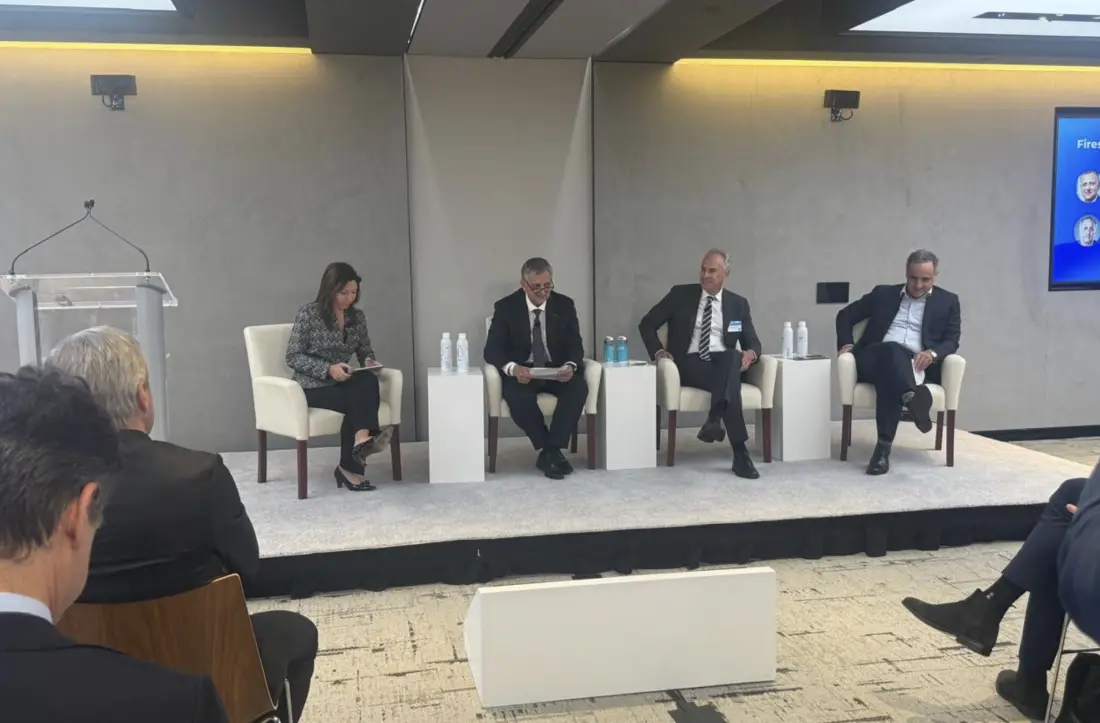
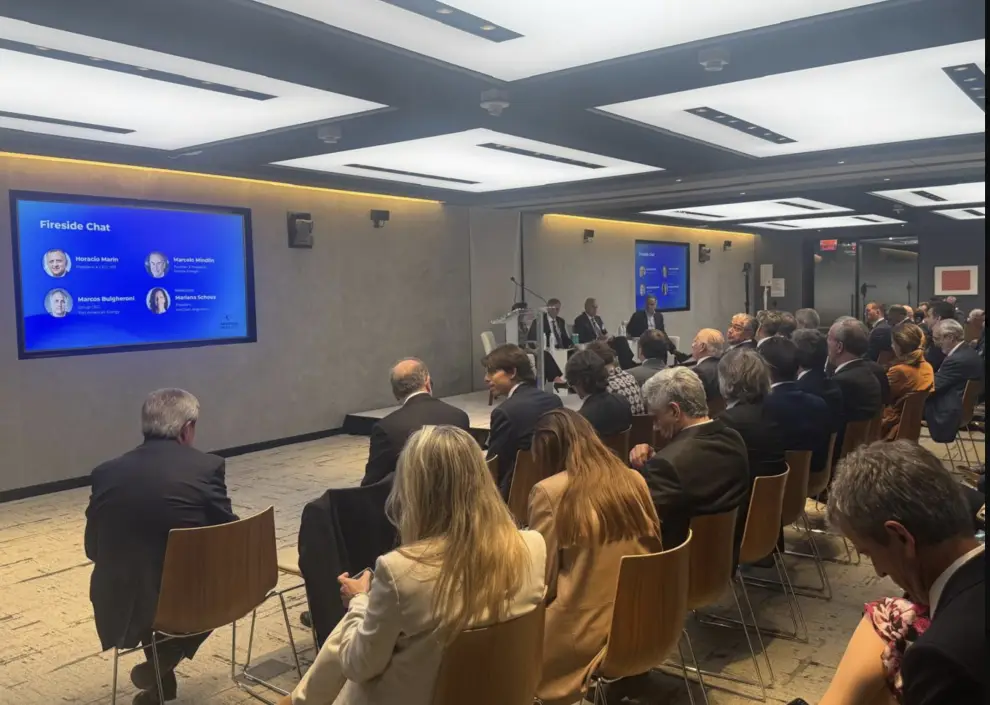
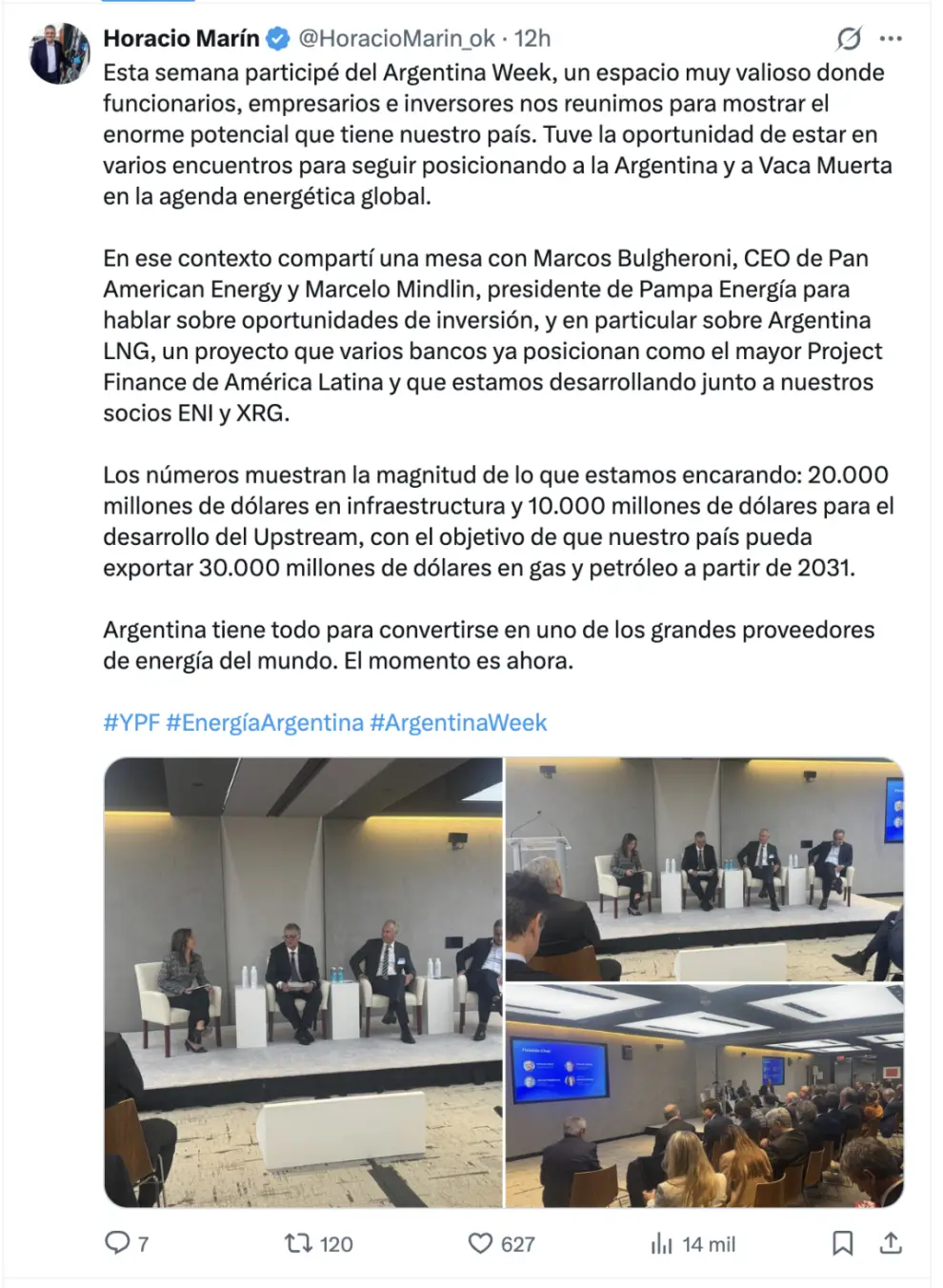
On the sidelines of the event, Marín shared a table with Marcos Bulgheroni, CEO of Pan American Energy, and Marcelo Mindlin, chairman of Pampa Energía. The topic was the same — investment opportunities surrounding the project. The fact that the three executives were part of the same discussion signals the level of coordination Argentina LNG is beginning to generate among the sector’s major private operators.
There is also an expansion roadmap.
During 2026, the partners will evaluate the possibility of a third FLNG unit with an additional 7 MTPA of capacity, with a potential FID in 2027 or 2028 and commercial operations by 2032. Capex for that phase is estimated at about $8 billion.
If executed, total capacity would reach roughly 19 MTPA — enough to place Argentina among the world’s ten largest LNG exporters once full capacity is reached.
The geopolitical argument Marín is taking to banks
The escalation in the Middle East is putting pressure on LNG supply routes from Qatar to Europe. For YPF, that context is not merely background — it has become an active argument in discussions with banks.
In a scenario where traditional supply routes face disruption, European and Asian buyers have additional incentives to diversify long-term supply sources. Argentina, backed by the geological scale of Vaca Muerta and the regulatory framework provided by the RIGI, positions itself as that alternative.
Market logic supports the case.
What happened in New York this week is not an isolated episode. The project finance market for Argentine energy is building a level of depth not seen since the 1990s.
The Vaca Muerta Oil Sur pipeline set the model. Meanwhile, the dedicated pipeline planned by Southern Energy — which will connect Vaca Muerta with liquefaction vessels in the Gulf of San Matías — is negotiating a syndicated loan close to $1 billion. Each deal that closes lowers Argentina’s perceived country risk for the next.
JPMorgan documented that logic when it described VMOS as the beginning of a new wave of investment in Argentina — a deliberate test of international appetite for Argentine risk.
Argentina LNG is the first major bet that the wave is already underway.