
Power


IMPSA expects to put about 1,500 workers on Venezuela's Tocoma hydropower project next year, President Jorge Salcedo said.
The figure, which did not appear in the company's August announcement, came as Salcedo laid out a two-track strategy for the Mendoza-based maker of hydro and nuclear equipment: modernizing existing hydropower plants across the Americas and securing a place in the U.S. supply chain for small modular reactors (SMRs).
The common thread is an argument that starts in Mendoza province, which, he said, holds within its borders the complete chain needed to build a hydropower plant.
IMPSA was founded in 1907 as a Mendoza metalworking shop that cast spare parts and built sluice gates for the province's irrigation canals. On Sept. 18, at the Hilton hotel in Mendoza city, Salcedo joined the Shale24-Santander Mendoza Energy Summit panel on energy planning, hydropower, nuclear energy and domestic manufacturing of capital goods.
The panel was moderated by Flavia Royón, a national senator and former Argentine secretary of energy and of mining, and also included Mauricio Pinti Clop, general manager of EMESA, Mendoza's provincial energy company, and Vanesa García, deputy manager of the Sierra Pintada uranium mining and milling complex run by Argentina's National Atomic Energy Commission (CNEA). This article reconstructs his remarks from the panel recording and complements them with technical data the company publishes on its capabilities.
A Complete Supply Chain in One Province
Salcedo opened with what, in his view, sets Mendoza's hydropower industry apart: a complete supply chain within the country. IMPSA's manufacturing capacity, he explained, is backed by a network of neighboring workshops and suppliers in Godoy Cruz and the surrounding region that can take on any hydropower project. According to Salcedo, the company could today manufacture an entire hydropower plant.
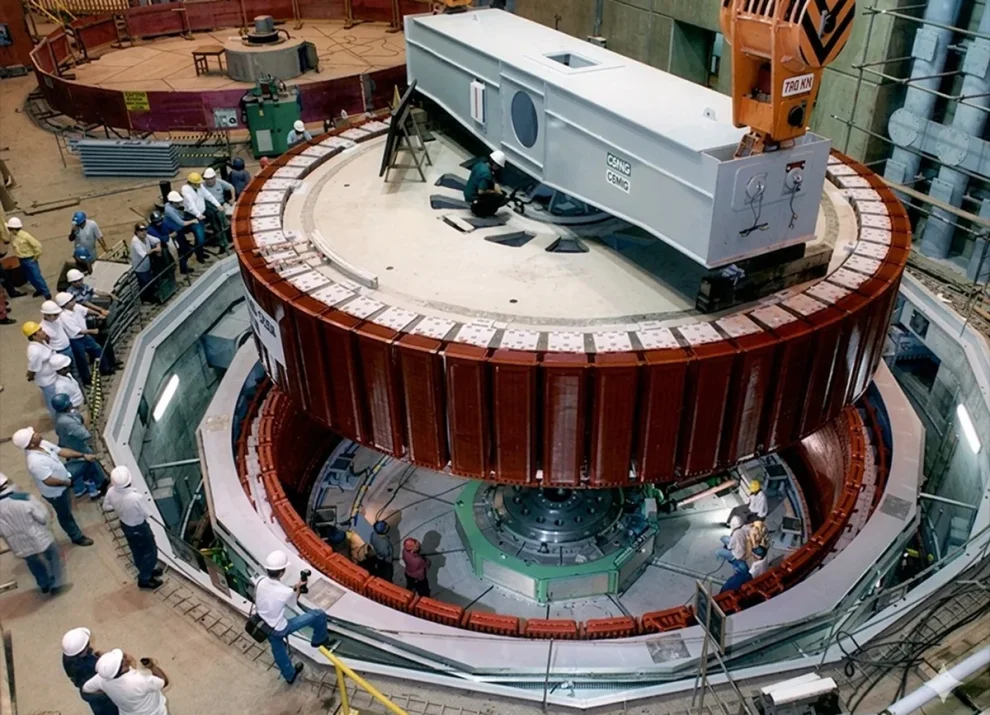
That capacity has a concrete address. The company's Technology Development Center occupies a 28-hectare site on Carril Rodriguez Pena, with 20,000 square meters of covered production space divided among boilermaking, machining, a synchronous generator bay, a structures bay, heat treatment and the so-called Nuclear Room, where components for nuclear plants are assembled.
The machine park includes an Ingersoll machining center that the company describes as one of a kind. The hydraulic design of each turbine is developed in an in-house laboratory, where performance is verified through reduced-scale model tests before the full-size machine is built.
According to its corporate data, IMPSA has installed more than 50,000 MW in over 40 countries. In Mendoza, its name is tied to the Potrerillos dam, which the company developed under a build-operate-transfer model. Outside the province, it was awarded the rehabilitation of six Kaplan turbines at Yacyreta, the binational hydropower plant on the Parana River.
Even so, Salcedo was realistic about the market. Worldwide, he acknowledged, few new hydropower plants are about to break ground. The opportunity lies in modernizing existing ones, and that applies to Argentina as well.
Tocoma, More Than a Decade Later
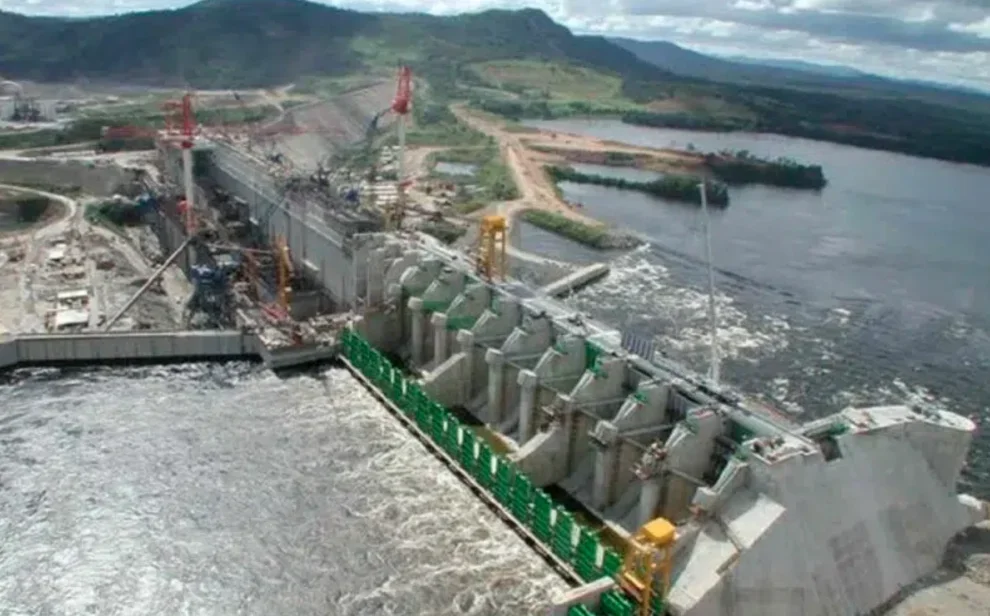
The most visible piece of that strategy is in Venezuela. Salcedo reviewed the contract IMPSA signed with Corpoelec, Venezuela's state power company, to modernize the Macagua plant and complete Tocoma, with the support of the U.S. government, authorization from the Treasury Department and backing from the White House.
According to the company's August announcement, the first stage restores 432 MW at Tocoma, with units 1 and 2, and 240 MW at Macagua, with units 4, 5 and 6: 672 MW in 24 months. The master plan agreed with Corpoelec calls for reaching 2,640 MW across both plants, 2,160 MW at Tocoma and 480 MW at Macagua.
The two Tocoma machines are 216-MW Kaplan turbines, the same model as the ten units in the original project, which the company's corporate history describes as "the most powerful Kaplan turbines ever built." Much of that equipment spent more than a decade in IMPSA's Godoy Cruz warehouses, waiting for the project to be unblocked.
Asked about the workforce, Salcedo said IMPSA expects to have about 1,500 employees working at Tocoma next year. That, he explained, will mean exporting Argentine human capital and reactivating the network of Mendoza and Argentine suppliers that historically supported these projects.
Royón admitted to some envy at a project of that scale in the region and asked what Argentina, which has nearly 20,000 MW of hydropower projects in its pipeline, is missing to take on a large plant again.
"In the end, all these projects depend heavily on financing," Salcedo replied. Energy, he added, is a business like any other. In his view, new mining projects and the expansion of Vaca Muerta will demand more megawatts, and Argentina has plants left half-built, with advanced works, that could be completed with a sound economic feasibility study. Mendoza, he said, has one of those opportunities, and other provinces do too.
The difference with Venezuela, according to Salcedo, lies in where the money comes from. There, financing comes from the United States to restore basic-services infrastructure. In Argentina, he anticipated, expansion will come through private capital.

North America Through Modernization
IMPSA's other hydropower front is the United States. Salcedo said that market has started moving again on equipment refurbishment, and that IMPSA already provides engineering to large generators such as the Tennessee Valley Authority (TVA).
The commercial gateway is the alliance the company signed in May with National Electric Coil (NEC), a U.S. company with more than a century of history that manufactures stator and rotor windings for high-voltage generators.
The agreement makes NEC IMPSA's partner in offering turbines, generators, electromechanical components and control systems in the United States, Canada, Mexico and Central America. On the panel, Salcedo added that the partnership also targets the supply of turbine runners, the component that converts the water's energy into rotation.
From Hydro to Nuclear
The second half of his presentation crossed industries. Salcedo argued that Argentina's hydropower sector resembles its nuclear industry in one respect: in both, the country holds the entire supply chain. In nuclear, he explained, it runs from uranium to power generation.
IMPSA, he said, worked to become a reliable supplier of electromechanical components for nuclear plants and is today a critical supplier to Argentina's reactors. The track record supports the claim. According to the company's technical profile, IMPSA supplied much of the heavy equipment for Atucha II, including steam generators, heat exchangers and pressurizers; manufactured four steam generators for the life-extension project at the Embalse nuclear plant; and designed and built the pressure vessel for CAREM 25, the CNEA's prototype modular reactor.
The company says it is the only one in Latin America holding the American Society of Mechanical Engineers (ASME) nuclear certification to design and manufacture Class 1 nuclear components to its own designs.
The new step is SMRs. Salcedo said IMPSA has already become a critical supplier to that segment and manufactures pressure vessels, containment vessels and heat exchangers for the U.S. market. In Argentina, he said, it is a supplier to the ACR-300, the modular reactor Meitner Energy proposes to build at the Atucha nuclear complex.
His diagnosis of that market focused on manufacturing. In the United States, he explained, there is very large investment in SMR development and many advanced designs, but few have reached the manufacturing stage and "few have the capacity to have a reliable supply chain." "That is where Argentina stands out," he said. A modular reactor developer that comes to the country, he added, finds everything from manufacturing to uranium mining.
The company has also taken that pitch to Vienna. At the General Conference of the International Atomic Energy Agency (IAEA), its commercial director, Mario Croce, presented IMPSA's capabilities in equipment for dry storage of spent nuclear fuel, components for transporting radioactive materials, and engineering and manufacturing for SMRs.
Salcedo closed on an optimistic note, in line with the stage that opened when the U.S.-backed Industrial Acquisitions Fund (IAF), a consortium led by ARC Energy, acquired the company in February 2025 in the Milei administration's first privatization: the opportunities opening up for Argentina and Mendoza through IMPSA, he said, are limitless. The workshop that started out building gates for irrigation ditches now offers pressure vessels for reactors in the other hemisphere. Both come out of the same site in Godoy Cruz.