
Enery Policy


The Falkland Islands (Malvinas) government has approved work on an oil-royalty sovereign wealth fund that enters force in 2030, two years after first oil.
The Executive Council (ExCo), the territory's senior decision-making body, cleared the workstreams on March 24, 2026, on the basis of ExCo Paper 76/26, signed by the Financial Secretary.
The paper estimates that hydrocarbon development offers the Falkland Islands Government (FIG) roughly $2 billion in royalty income over the 30 years covered by phases 1 and 2 of the Northern Development Area of Sea Lion, the offshore oil field in the North Falkland Basin. It also records that the legal structure, governance, investment decisions, use of monies and enabling legislation all remain subject to further ExCo approvals.
That sequencing is what makes the file worth watching from outside the South Atlantic. On the published timetable, the first royalty payments arrive before the vehicle designed to receive them exists in law.
Whether the gap matters in practice will depend on variables the paper cannot yet resolve: the operator's progress to first oil, the pace of legislative drafting, and a consultation stage that has not yet begun.
A Backbench Motion Became a Legislative Priority
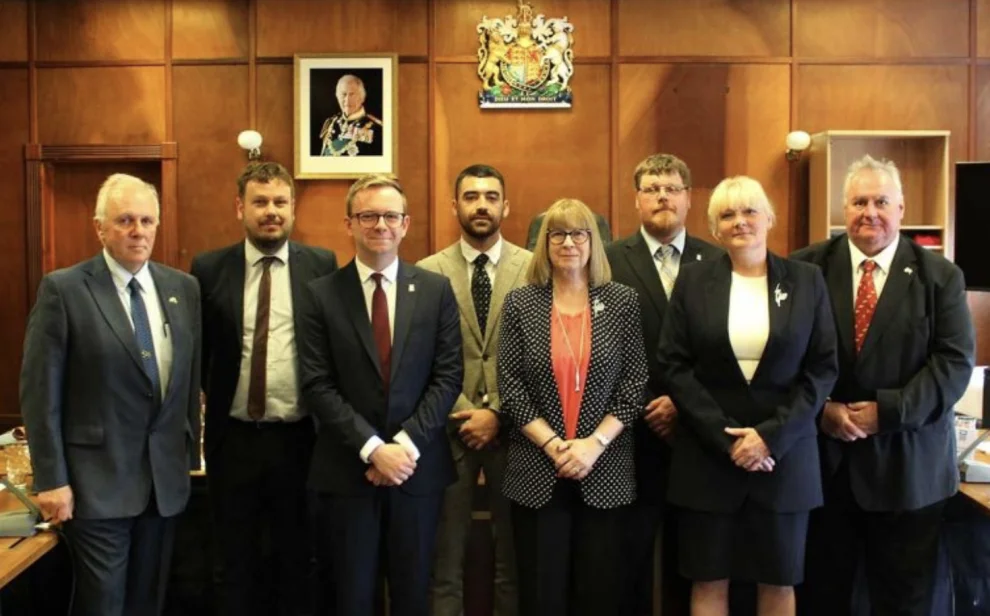
The measure originates in motion 03/26, put to the Legislative Assembly on January 29, 2026 by MLA Lewis Clifton OBE, a Member of the Legislative Assembly, six weeks after the Assembly's first plenary session. The motion calls on the Governor in Council to bring forward legislation establishing and managing a sovereign wealth fund before the end of the Assembly's third year. Annex A of the paper records that the motion passed and that the item was identified as a high priority for the legislation programme.
The fund would be built on the Santiago Principles, the 24 voluntary guidelines on transparency, governance and prudent investment agreed in 2008 by the International Working Group of Sovereign Wealth Funds and maintained since by the International Forum of Sovereign Wealth Funds (IFSWF).
The paper reports that contact was made with the IFSWF, which offered support and pointed the islands' government toward the experience of Guyana, Sarawak in Malaysia, the Shetland Islands and Papua New Guinea. The internal working committee draws on the Legal, Natural Resources, Policy and Treasury departments, together with a representative with experience of the Norwegian fund.
One paragraph of the file records that a paper with the same object was drafted in 2019 and never presented. The reason is unknown.
The Timetable Runs Two Years Behind the Barrels
The project plan sets out the stages one by one. Detailed policy development from April 2026, running eight months. Consultation with Assembly members, with the U.K. Foreign, Commonwealth and Development Office (FCDO) and with the public from January 2027, running four months.
Revision in May 2027, policy approval in July, drafting instructions in August. Legislative drafting begins in January 2028 and takes 12 to 18 months. Consultation on the draft bill runs from January to June 2029. Assembly approval falls between May and November 2029. Commencement in 2030.
First oil from Sea Lion is scheduled for the first quarter of 2028, according to the development plan published by operator Navitas Petroleum, the Israeli oil and gas company. The paper acknowledges that its schedule depends on the operator's progress toward first oil and first royalty payment, and flags as its principal risk that the work is carried out in anticipation of oil that then fails to arrive.
That the FCDO appears among the consultees is not a formality. The paper notes that the Finance and Audit Ordinance 1988 sets out the requirements for special funds, including approval by the U.K. Secretary of State, so the vehicle's architecture passes through the British government at some point in its construction.
The 2013 Attempt That Left No Trace
The islands' administration has tried this before. With the Sea Lion discovery still fresh and the sovereignty referendum just held, official delegations travelled to Norway and to the Shetland Islands, which have run a trust funded by North Sea revenues since 1976.
The Sovereign Wealth Fund Institute recorded a first deposit of £8.3 million into an oil development reserve at the time. Projections circulating in 2013 pointed to $10.5 billion in fiscal revenue over 25 years.
That reserve does not appear among the special funds the islands' government declares today. Its official budget lists five: the legacy pension scheme fund, the retirement pension fund, the capital equalisation fund, the insurance fund and the currency fund. None relates to hydrocarbons.
The same budget carries a revenue line labelled "Oil Revenue" alongside a general table specifying that it excludes oil. The line has existed for several financial years and its value is zero.
What the Royalty Estimate Rests On
The paper limits the $2 billion figure to phases 1 and 2 of the Northern Development Area. The plan Navitas presented to investors in August covers three phases and 39 wells in the northern area, holding 420 million barrels of oil equivalent in proved plus probable reserves (2P) plus best-estimate contingent resources (2C), and a further two phases and 38 wells in the central area holding 403 million. The total comes to 77 wells and 823 million boe, according to the operator.
The central area portion is contingent resource. Its conversion depends on approval of a commercial development plan, on regulatory permits and on a subsequent investment decision. Production from that area is declared for late 2030, the same year the fund ordinance is due to take effect.
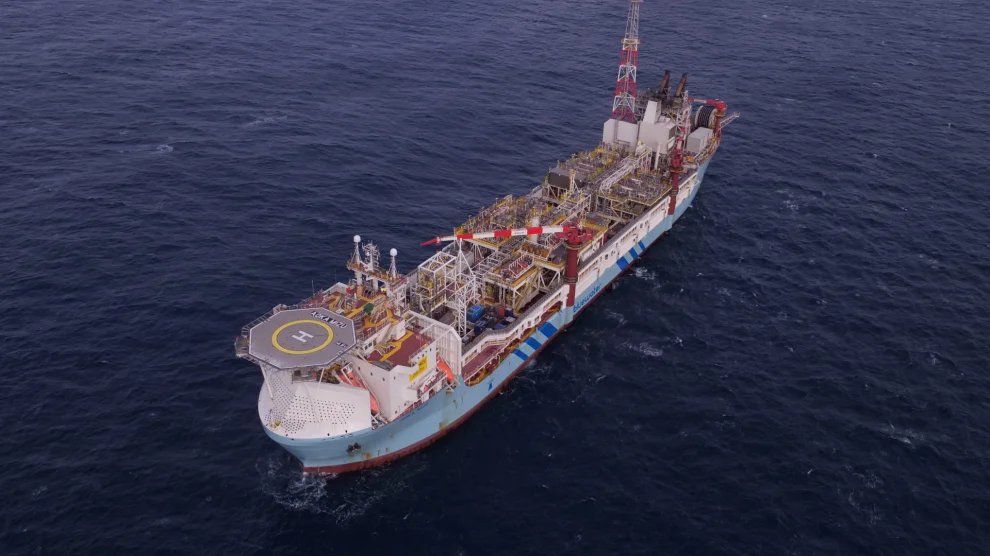
Installed capacity for the first two phases is 55,000 bbl/d on the floating production, storage and offloading unit (FPSO) Aoka Mizu. The operator has also moved ahead with a second floating production unit for the central area.
On August 24 the operator published a project update. Work in the islands is concentrated on preparing the jetty and the onshore support base, on building accommodation, and on infrastructure to receive the drilling rig. Drilling starts in early 2027, the same window in which the islands' government plans to open its public consultation on the fund.
The Aoka Mizu has disconnected from the field it previously served and is sailing to a Southeast Asian shipyard, with arrival expected in early September.
Navitas has said it will submit the central area development plan to the islands' government for approval and take a final investment decision (FID) on that plan in the first half of 2028. The programme covers 20 wells in the first phase and 18 in the second, with production targeted for late 2030.
The central area file therefore reaches the islands' administration after the first barrel and two years before the fund ordinance takes effect. The four posts the Executive Council created in March are the ones that will have to assess it.
The company is also weighing additional exploration during the phase 1 drilling campaign, with one well on the licence covering the discovery area and the deepening of a development well toward the Gwendoline prospect.
Argentina's Sanctions Regime Covers the Whole Chain
For Argentina, all of this activity takes place on its continental shelf without national authorisation. The penalty regime under Law 26,659, Argentina's 2011 statute barring unauthorised hydrocarbon activity on the Argentine continental shelf, reaches operators, their shareholders and anyone taking a stake in the project.
Two calendars are now running against each other in the South Atlantic. One puts a royalty vehicle into force in 2030. The other exposes anyone who helps produce those royalties to Argentine penalties from the moment the first barrel is lifted.