
Vaca Muerta Oil Sur Pipeline
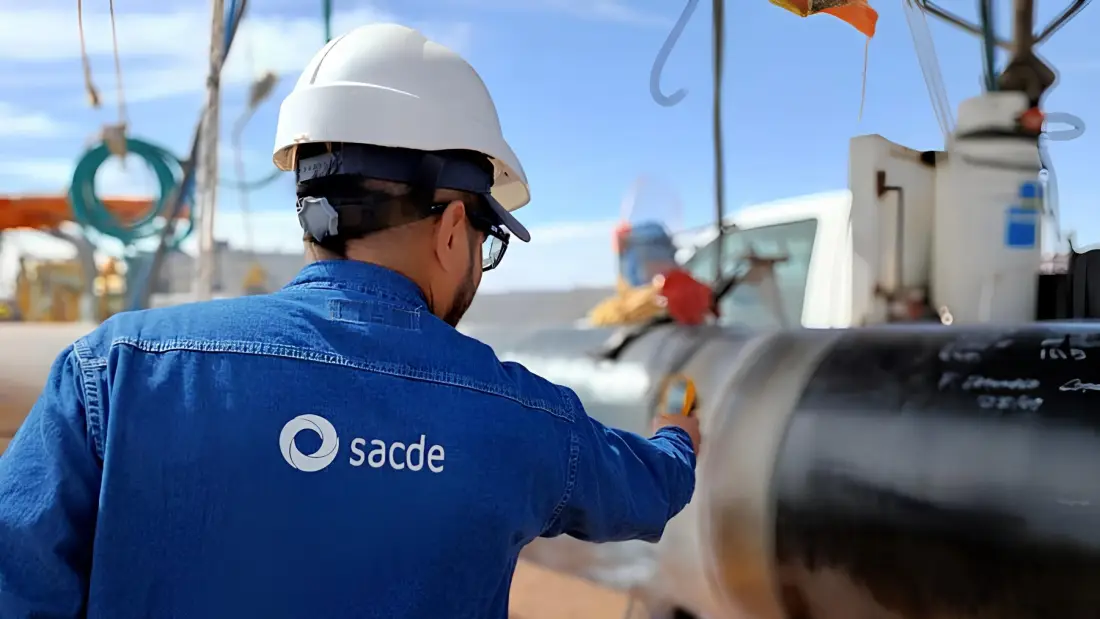
The Vaca Muerta Oil Sur (VMOS) pipeline megaproject, regarded as the largest privately funded energy infrastructure development in Argentina in the past 50 years, is advancing at a rapid pace. Built by the Techint–SACDE temporary consortium, the project is now completing surface installation and is expected to soon begin the phase of hydraulic pressure and strength testing ahead of its early start-up, scheduled for the third quarter of 2026.
In this context, SACDE has stepped up its recruitment of specialized workers, particularly for complementary pipelines. The company is seeking pipefitters, truck drivers and heavy-equipment operators — including hydrocranes, motor graders, front loaders and backhoes — as well as welders. The hiring drive prioritizes local labor in the provinces of Neuquén and Río Negro, with applications submitted through official channels.
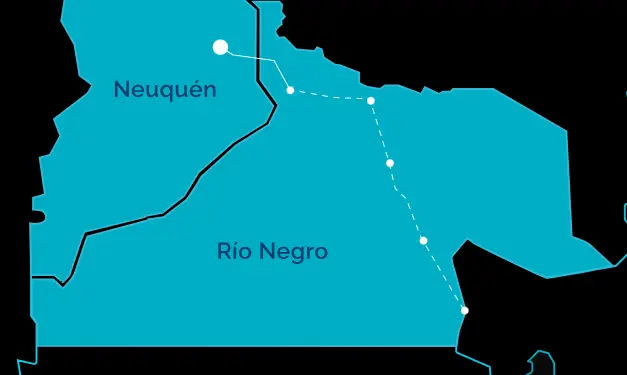
In November, the project reached a key milestone: completion of the final automatic weld on the main pipeline’s regular line, carried out at the entrance to the new Punta Colorada Port Terminal. This marked the end of the trunk line installation along the 437-kilometer pipeline, linking the Allen pumping station in Río Negro with the Atlantic coast to enable direct crude exports.
Sources at VMOS S.A. — the consortium led by YPF and comprising Vista, Pan American Energy, Pampa Energía, Chevron, Pluspetrol, Shell, Tecpetrol and Gas y Petróleo del Neuquén — confirmed that early operations are planned for the third quarter of 2026. Initial capacity is set at 190,000 barrels per day, rising to 390,000 bpd in 2027 and up to 550,000 bpd in later phases, with potential expansion to 700,000 bpd through additional investment.
Technical details
The 30-inch-diameter (762 mm) pipeline uses steel pipes measuring between 12 and 24 meters, joined using high-precision orbital automatic welding technology. Construction set productivity records, with up to 175 welds completed in a single day — equivalent to more than 4 kilometers of progress — involving Turkish specialists and more than 100 Argentine welders.
The route includes 76 special crossings, such as highways, streams, canals and railways, and mobilized more than 200 heavy machines across challenging Patagonian terrain. Pending work includes linear tie-in welds, hydraulic testing and the underground crossing of the Río Negro River using state-of-the-art horizontal directional drilling, scheduled for December 2025, with an emphasis on minimizing environmental impact.
Complementary infrastructure includes intermediate pumping stations in Allen and Chelforó, an onshore storage tank farm with scalable capacity of up to 600,000 cubic meters, and a port terminal featuring two offshore single-point moorings for loading VLCCs (Very Large Crude Carriers).
Most recently, a vessel arrived at the port of San Antonio Este carrying 130 modular housing units and 140 containers to set up a central construction camp, strengthening logistics for the project’s final stages.