
New global order


In a world where energy security has become synonymous with national security, recent statements at global forums such as the Munich Security Conference and the World Economic Forum in Davos highlight the magnitude of the challenge.
“Energy and geopolitics were always interwoven but I have never ever seen that the energy security risks are so multiplied," said Fatih Birol, executive director of the International Energy Agency (IEA), during discussions in Davos in January 2026. “Energy security, in my view, should be elevated to the level of national security today.”
This warning resonates particularly strongly amid a global order in flux, where supply chain fragmentation, great power rivalries, and an accelerated energy transition are pushing Europe and the West to seek reliable partners and competitive resources. Argentina, with its Vaca Muerta shale formation and critical minerals, emerges in this context as a strategic actor.
The YPF-Eni-XRG Agreement: A Milestone in Monetizing Vaca Muerta
The central event of the week in the energy sector was the signing of a binding Joint Development Agreement (JDA) between YPF, Eni, and XRG — the international energy investment arm of Abu Dhabi National Oil Company (Adnoc). The agreement formally brings XRG on board as a founding partner of the Argentina LNG project, a large-scale integrated venture aimed at producing, liquefying, and exporting natural gas from Vaca Muerta’s shale resources.
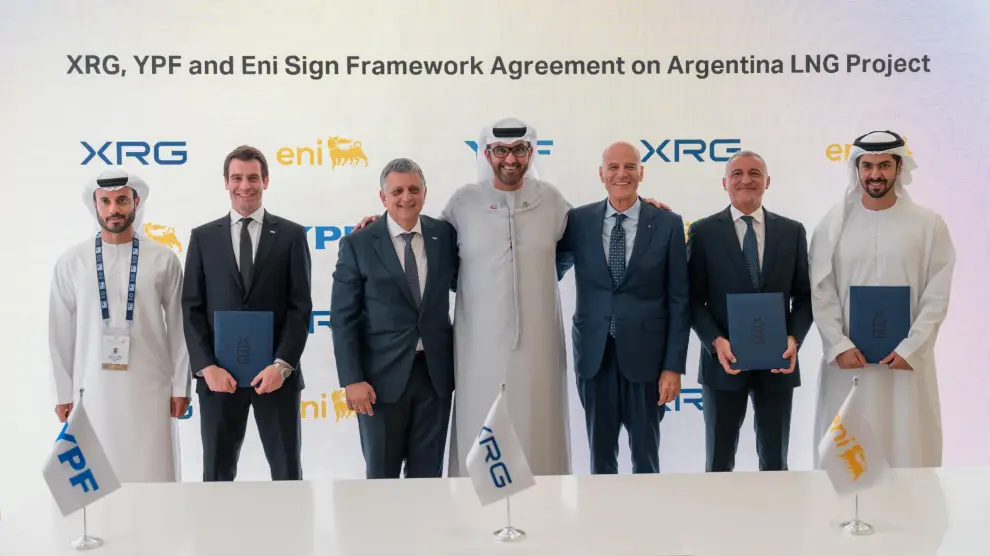
Technically, the project envisions an initial capacity of 12 million tons per year (MTPA) of LNG, through two floating liquefaction units (FLNG) of 6 MTPA each. The scheme integrates the full value chain: ramping up gas production in Vaca Muerta (requiring roughly US$12 billion for well development), transportation infrastructure (a 48-inch pipeline, oil pipelines, and multi-product pipelines), and liquefaction and export facilities on the Atlantic coast, primarily in Río Negro province. Total estimated investment is US$29.5–30 billion, of which around US$17.5 billion corresponds to surface infrastructure.
The JDA immediately triggers the front-end engineering design (FEED) phase, along with technical, commercial, and financial structuring. A final investment decision (FID) is expected in the second half of 2026, with commercial operations projected to start around 2030.
YPF’s chairman and CEO. Horacio Marín, highlighted that the agreement positions the project as one of the world’s most significant, with potential to double Vaca Muerta’s gas output and generate US$10 billion annually in exports for at least two decades, alongside up to 50,000 direct and indirect jobs.
This development is part of YPF’s 4x4 Plan, aiming to transform the company into a structural hydrocarbon exporter by 2031, leveraging Vaca Muerta’s cost competitiveness — among the world’s lowest-cost shale plays — and FLNG technology, which shortens timelines and reduces costs compared with traditional onshore plants.
Argentina and European Demand: A Strategic Window for LNG
The timing of the agreement is highly favorable in the global context. The European Union has activated the final phase of its REPowerEU strategy, with Regulation EU/2026/261 setting an irreversible schedule to eliminate Russian gas imports: a total ban on short-term LNG contracts from Russia starting in April 2026, and a complete phase-out of all Russian supplies (pipeline and LNG) by the end of 2027.

Europe faces a structural gas deficit: LNG demand remains high at roughly 150–160 bcm annually post-2022, driven by industrial decarbonization and the need to back up renewable energy. Countries such as Germany, Italy, and the Netherlands are seeking “pro-Western” suppliers with low geopolitical risk and controlled carbon footprints. Argentina emerges as a highly competitive option:
- Logistical proximity: LNG carriers from Patagonia can reach Europe in 15–20 days, with shipping costs lower than distant Asian competitors.
- Resource quality: Gas from Vaca Muerta has low emissions intensity (methane and CO₂), aligning with European Methane Regulation and facilitating “green” LNG certification.
- Concrete precedents: Existing commitments, such as a memorandum with Germany’s SEFE for up to 2 MTPA starting in 2027, illustrate market traction, and the Argentina LNG project aims to capture a significant portion of residual European demand.
With an initial capacity of 12 MTPA (~16–17 bcm/year), Argentina LNG could cover 10–12% of Europe’s non-U.S. LNG imports by 2030, positioning Argentina as a structural supplier in a market that values contractual stability and geopolitical alignment.
The Geopolitical Dimension: Quirno at the Munich Security Conference
At the same time, Argentine Foreign Minister Pablo Quirno’s participation in the 62nd Munich Security Conference reinforced the strategic framing of these energy developments. On the panel “Raw Power: The Geopolitics of Resources,” Quirno emphasized strategic partnerships with the United States in critical minerals (lithium and copper), stressing their geopolitical importance over commercial considerations:
"It is not about trade. It is not about having projects that are standalone. Everything has to have, today, a strategic purpose, because it is critical for the future growth of the West," he said.
Argentina, holding 20% of the world’s lithium reserves, has attracted more than US$14 billion in copper projects under the Large Investment Incentive Regime (RIGI). The recent agreement with Washington prioritizes the U.S. as a preferred partner, while not excluding existing Chinese investments.
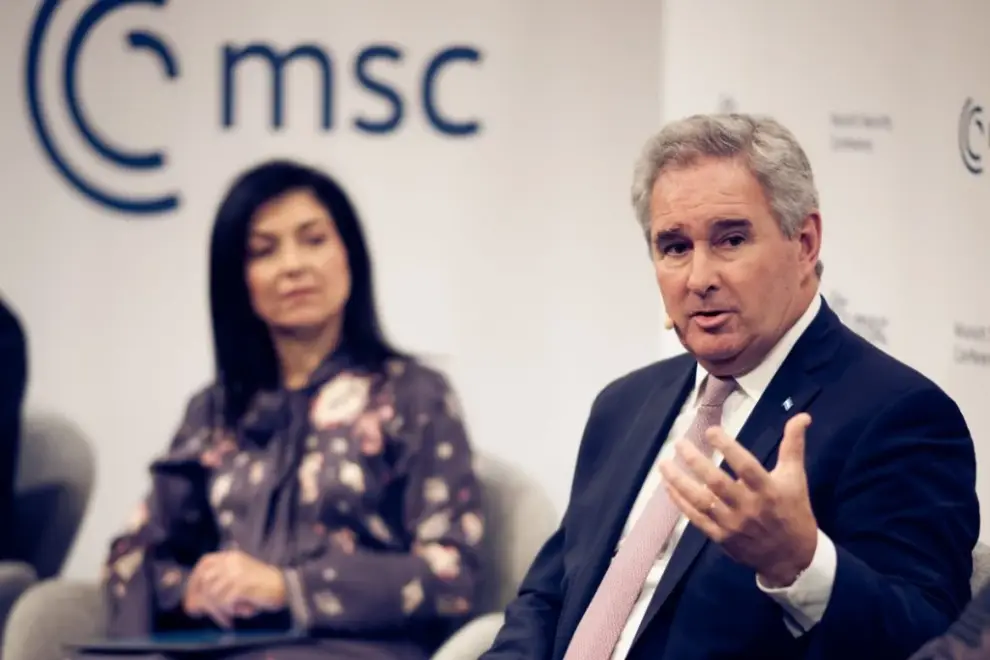
Quirno explicitly linked these resources to the global energy transition and extended the message to hydrocarbons, highlighting LNG projects in Vaca Muerta in partnership with the UAE, and reaffirming alignment with Western energy security goals. This pragmatic, pro-Western but non-exclusive geopolitical narrative strengthens Argentina’s image as a reliable partner for Europe, seeking secure supply chains for both battery minerals and transitional LNG.
The YPF-Eni-XRG agreement represents a qualitative leap in Vaca Muerta’s export maturity, moving from exploration to industrial execution. Its success will depend on technical FEED execution, financial structuring (with international banks already engaged), and the realization of offtake contracts, particularly with European buyers. For Argentina, this entails not only foreign exchange and employment, but deeper integration into global energy markets.