
Oil&Gas
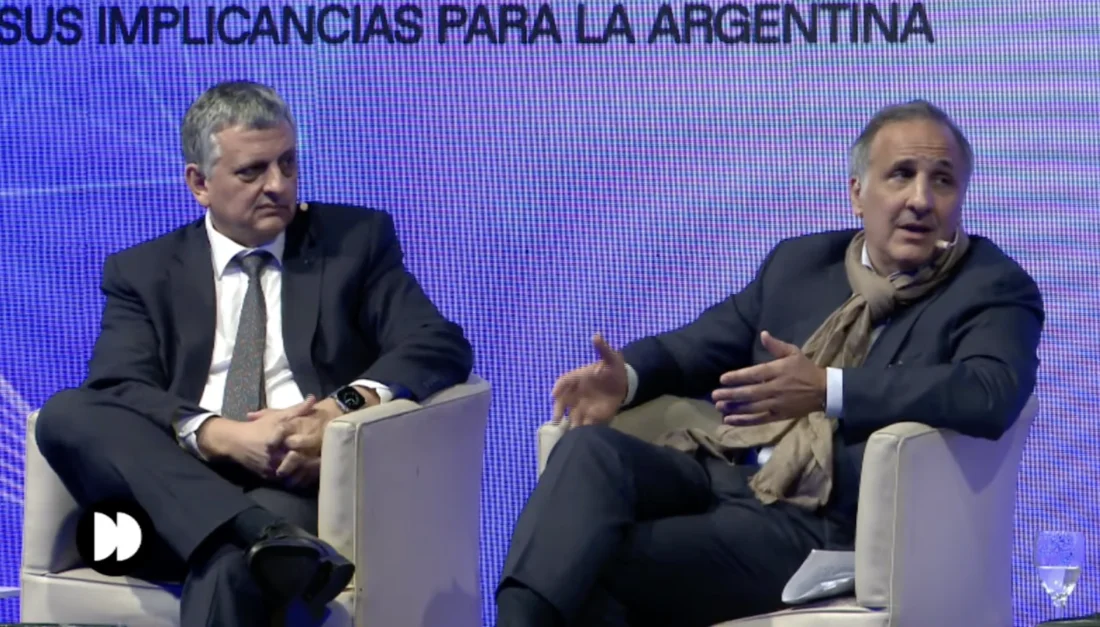
Marcos Bulgheroni, Group CEO of Pan American Energy (PAE), Argentina's largest private oil producer, has cast Argentina as "the stable variable" of a dislocated global gas market — one positioned to take share as the four dominant LNG suppliers all head into trouble.
He delivered the argument on the closing panel of the seventh Democracia y Desarrollo forum, an annual Argentine policy conference, sharing the stage with Horacio Marín, chairman and CEO of YPF, Argentina's state-controlled oil and gas company. While Marín focused on financing the country's liquefied natural gas (LNG) project, Bulgheroni offered a wider market read, running from the Middle East crisis to how to monetize Argentine gas without selling it as a bulk commodity. These are ten of his points.
1. The Hormuz Premium Is Here to Stay
Bulgheroni opened with the scale of the disruption. The full closure of the Strait of Hormuz, he said, "is something that had never happened before" — not even during the 1973 Arab oil embargo — on a corridor that carries close to 20% of the world's hydrocarbons. The price move was immediate: "That made the price jump from $60 and double to $120 a barrel," he said.
The International Energy Agency (IEA) has described the episode as the largest supply disruption in the history of the global oil market. For the executive, the key is not the spike but what persists: a permanent risk premium on every flow crossing Hormuz, "which will translate into higher insurance and transport costs."
2. Energy Is Back at the Center
Bulgheroni spent a stretch dismantling a received idea. "The theory that digitalization, technology and artificial intelligence would replace energy now has to be viewed with skepticism," he said. His argument: when the system is stressed, priority returns to the physical. "When the chips are down, when there's a crisis, the axis of what matters goes back to energy, back to infrastructure," he said, linking that to supply diversification as buyers' new obsession. The IEA itself has warned that damage to Qatar's liquefaction infrastructure will delay the next wave of LNG supply.
3. The Four Largest LNG Producers Are All Exposed
The executive placed Argentina's opportunity in the cracks of the market leaders. The global LNG market moves today at around 400 to 430 million tonnes per annum (MTPA) and, on his reading, would climb toward 650 MTPA. The three biggest suppliers — the United States, Qatar and Australia — each hold close to 20%, with Russia at about 8%. "These first four producers are going to have problems," he forecast.
He detailed each: U.S. gas depends on the Panama Canal ("a risk in cost and geopolitical terms") and will have to compete for the molecule with gas demand from artificial intelligence; Qatar carries its geographic exposure; and for Russia, "sanctions limit its financing, limit its access to Western technology, and the European buyers, who are the ones who pay the most, won't be there."
4. Argentina's Four Advantages
Against that backdrop, Bulgheroni laid out the local cards. The first is the Vaca Muerta resource, which he considers competitive on price even against the benchmark rival, the United States. The second is geography: "We're far from the geopolitical disorder; we don't have to pass through Hormuz, or the Red Sea, or the Panama Canal," with access to two oceans. The third is Argentina's Large Investment Incentive Regime (RIGI): "It drastically changed investors' view; access to foreign currency is a key element," along with fiscal stability. The fourth, more political, is presenting Argentina as a reliable long-term supplier in a market dislocated by sanctions.
5. A "Stability Premium" and Southern Energy's Next 3 Million Tonnes
Here came one of the panel's strongest ideas. Bulgheroni recounted that when the PAE-led Southern Energy consortium (SESA) — which also includes YPF; Pampa Energía, a diversified Argentine energy company; the U.K.'s Harbour Energy; and Norway's Golar LNG — went to sell 2 million tonnes to Germany, the state buyer agreed to pay something above market in order not to end up, in its words, "as the ham in the sandwich between Putin and the United States."
The result, he quipped, turned those executives into "national heroes." That deal — a 2-MTPA supply agreement with Germany's SEFE Securing Energy for Europe, firmed into a binding sale and purchase agreement (SPA) in March — is now being followed by a tender for 3 million additional tonnes, betting on capturing "a kind of premium for being stable." His summary: Argentina has become "the stable variable of the market."
6. Vaca Muerta Did Not Appear Overnight
Bulgheroni asked the audience to look at the road already travelled before projecting forward. "This didn't come out of nowhere; it's not instantaneous," he said, recalling that Repsol drilled more than 60 derisking wells in the basin "to understand what was in each spot," with YPF later leading the push. His sharpest comparison was about timing: "Today we're in Vaca Muerta where shale was in the United States in 2008" — the point just before the exponential production curve. The derisking, the gathering systems and the trunk pipelines are already in place, so the watchword has turned operational: "What we have to do as an industry is wells, wells, wells and wells," plus efficiency.
7. The Mistake of Talking Only About Vaca Muerta
The executive drew a line against the dominant conversation. "We're not doing the industry a service if we only focus on Vaca Muerta," he said, drawing the parallel: "The United States has a dozen unconventional basins; in Argentina we have at least three more." He named the San Jorge Gulf Basin, the Cuyana basin in Mendoza and the Austral Basin.
PAE has already drilled its first unconventional exploration wells there, alone. Bulgheroni did not sugarcoat the cost of learning: "Drilling a $30 million well that turns out to be useless is still worth it, because you learned."
8. Competition as the Engine: "I Compete with Shell and Exxon"
Far from asking for protection, Bulgheroni made the case for competition as a driver. "We compete every day. I don't just compete with YPF: I compete with Shell, with Exxon, with GeoPark," he said, calling ExxonMobil's exit from the basin — its Vaca Muerta assets were sold to Pluspetrol in 2025 — "a great shame." His thesis is that more operators benefit everyone, because they enable shared gathering, pipeline and infrastructure projects and accelerate learning. He invoked the U.S. model of basin specialization (Marcellus, Haynesville, Eagle Ford), where gas-only companies coexist with crude-focused ones.
9. Why Brazil Won't Save Argentine Gas
This was the segment most loaded with numbers and the most against the grain. Bulgheroni dismantled the idea of the regional market as a scale outlet. "Brazil, if it rains, buys zero gas," he illustrated, because of the weight of hydropower in its grid, which makes 20-year contracts nearly impossible to sign. He put the volumes on the table: Argentina produces some 130 million cubic meters per day (MMm³/d) of gas; Brazil runs around 200; Chile consumes close to 12 (plus 3 to 4 from the Atacama mining hub); Bolivia could take 10 once its own gas runs out; and Paraguay another 10 if it is connected. "We're talking about rounding errors," he summed up: the total regional increment does not exceed some 15 MMm³/d, against the roughly 100 MMm³/d that an 18-to-20-MTPA LNG project demands. Regional integration, on that arithmetic, does not move the needle.
10. The Next Chapter Is Industrialization, Not Commodities
The conceptual close was a thesis about value. "The next chapter won't be exporting commodities; it will be the industrialization of all those energy resources," he said. He gave two concrete PAE examples. The first: the petroleum coke from the Campana refinery, which — after an investment to bring it to specification — stopped being sold on the domestic market (to industrial conglomerate Techint, for blast furnaces) and is now exported to China "for batteries." The second: Escalante crude, placed for six or seven years among Arab buyers as a fuel-oil blending base.
He distilled it this way: "Argentina cannot afford, as it does in agriculture, to sell in bulk; you have to find the niches, invest and capture them" — a reference to the commodity-export model of the country's farm sector, historically its largest source of foreign currency.
Bulgheroni closed with a defense of the long horizon that aligned with Marín. In an industry where a well pays back "in 7 to 15 years," he warned, tying oneself to the electoral calendar is the recipe for not investing. "Private players are the ones who generate wealth, not the state," he finished, on a panel that presented Argentine energy as a long-term bet that has already begun to execute.