
MIDSTREAM

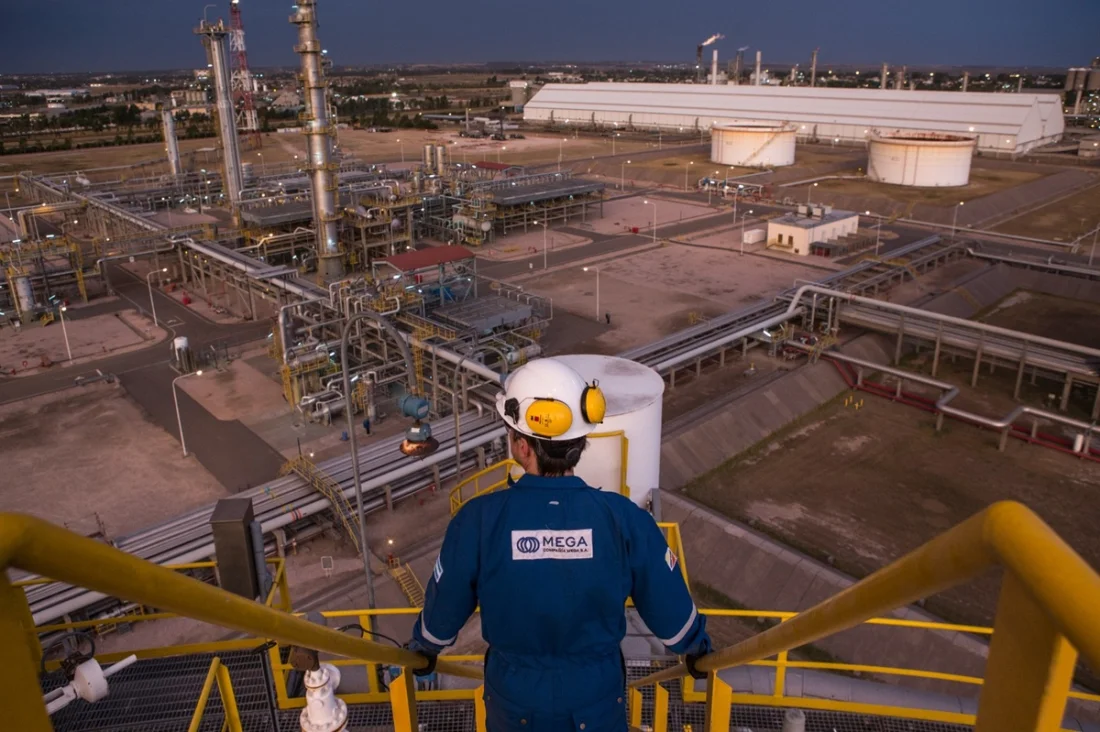
Compañía Mega, Argentina's largest NGL processor and exporter, is commissioning a new fractionation train and building two new pumping stations along its Loma La Lata–Bahía Blanca pipeline, as shale gas from the Vaca Muerta formation — one of the world's largest shale plays, located in Argentina's Neuquén Basin — increasingly alters the composition of its feedstock.
The company's 2023–2028 investment plan totals $650 million, and it has filed an additional $360 million phase for 2026–2028 under Argentina's Large Investment Incentive Regime (RIGI), currently awaiting approval.
The plan responds to a structural shift in feedstock. The gas reaching Mega's separation plant at Loma La Lata in Neuquén province comes increasingly from Vaca Muerta and today carries roughly 10% less methane than in 2001, three times as much ethane and propane, and four times as much natural gasoline.
"Our infrastructure growth looks ahead to what comes with LNG, but the change is already being driven by the rising share of unconventional gas rich in NGLs," said Tomás Córdoba, general director of Mega, in comments at a conference attended by Shale24.
The program's objective is to expand separation, transport, and fractionation capacity for natural gas liquids (NGLs). The plant structure pairs the separation head at Loma La Lata with the fractionation complex at Bahía Blanca, Buenos Aires province — Argentina's main industrial port and hub of its petrochemical and NGL export complex — connected by a 12-inch, 600-kilometer pipeline. Gas arrives mostly from YPF, Argentina's state-controlled oil and gas company, with a smaller supply from Tecpetrol, the Techint Group's exploration and production subsidiary, via the Fortín de Piedra shale gas project.

A 25-year shift in feedstock composition
Mega began operations in 2001 with a plant designed for a very different gas. At that point, the feedstock was dominated by methane at 91%, with ethane near 4%, propane below 2% and butane at 1%. The rest was residual components. Argentine gas is also essentially sulfur-free, which shortens processing time.
The rise of unconventional production from 2013 onward shifted that profile. Current inbound gas carries 10% less methane, triple the ethane and propane, and four times the natural gasoline. The target of the processing chain is unchanged — extract NGLs and monetize them — but the richness of the stream has raised the ceiling on what the plant can yield per unit of gas processed.
The expansion: modular and scalable
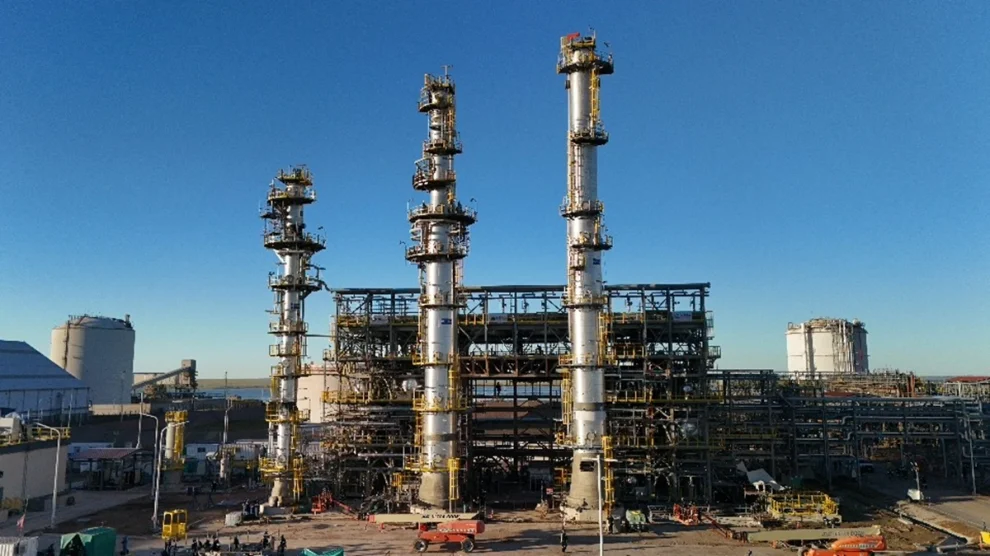
Mega currently processes around 4,800 tonnes per day of liquids. The program targets a 50% increase in two stages. The first 20% will come from the new fractionation train, scheduled to start up in the coming weeks. The remaining 30% will come from two pumping stations that construction firm PECOM is building in General Roca, Río Negro province, and Gaviotas, La Pampa province, along with other supporting work.
To accelerate the second phase, Mega filed it under the RIGI for $360 million. Alongside YPF — which holds 38% — Petrobras, Brazil's state energy company, and Dow Argentina, a subsidiary of the U.S. chemicals company, hold 34% and 28%, respectively. YPF's "Plan 4x4," aimed at expanding both crude output (and therefore associated gas) and gas supply for the upcoming LNG program, underpins shareholder support for the expansion.
A richer "soup" commands a higher price
A practical rule of thumb for Mega's economics: the value of the NGL "soup" — the blended stream of ethane, propane, butane and natural gasoline — runs between $6 and $7 per million British thermal units (MMBtu), while natural gas trades closer to $3 to $4 per MMBtu depending on seasonality. "It is a business that multiplies the price of gas through processing and monetizes the investment above the value of the raw material," Córdoba said.
Although the focus of Vaca Muerta development today remains crude oil, associated gas — which doubled in 2025 versus the prior year — and gas destined for LNG export are driving projects that complement Mega's chain. Those include Transportadora de Gas del Sur (TGS)'s NGL project, Argentina's main southern gas pipeline operator's $3 billion integrated processing build-out, and Pluspetrol's own processing capacity.
Mega remains the clearest example of the midstream link in the hydrocarbon chain. Upstream — extraction of oil and gas — and downstream — refining and marketing — anchor the chain at either end. In between sits the web of pipelines, plants and technology that moves hydrocarbons and captures additional value from components like NGLs. The central objective is to separate the valuable compounds from the raw gas stream and monetize them as efficiently as possible — all, some, or most of them, depending on the configuration.