
E&P INVESTMENT
Neuquén has compressed its licensing calendar by two years to align with two converging events: the early startup of Oldelval's Duplicar Norte crude pipeline and a specific request for additional acreage from Continental Resources, the U.S. shale company.
Gas y Petróleo del Neuquén (GyP), Neuquén province's state oil and gas company, will publish tender documents in May for 15 blocks drawn from its portfolio of reserved areas, with the formal opening of the process set for August 19, 2026. Bid submission will run for 90 days and awards will close before year-end.
The original calendar is worth recalling. At the Offshore Technology Conference in Houston in May 2025, Gustavo Medele, Neuquén's minister of energy and natural resources, said the province would be "ready in 2027" to launch licensing in 2028. The jump from 2028 to 2026 is not an operational detail. It is the distance between a long-term roadmap and a window opened by a specific customer.
Whether the compressed timeline holds will depend on factors the tender documents have not yet disclosed — among them entry fees, signing bonuses, minimum investment or drilling commitments, and whether blocks will be eligible for the RIGI or for the provincial incentive regime Neuquén introduced in February.

The catalyst
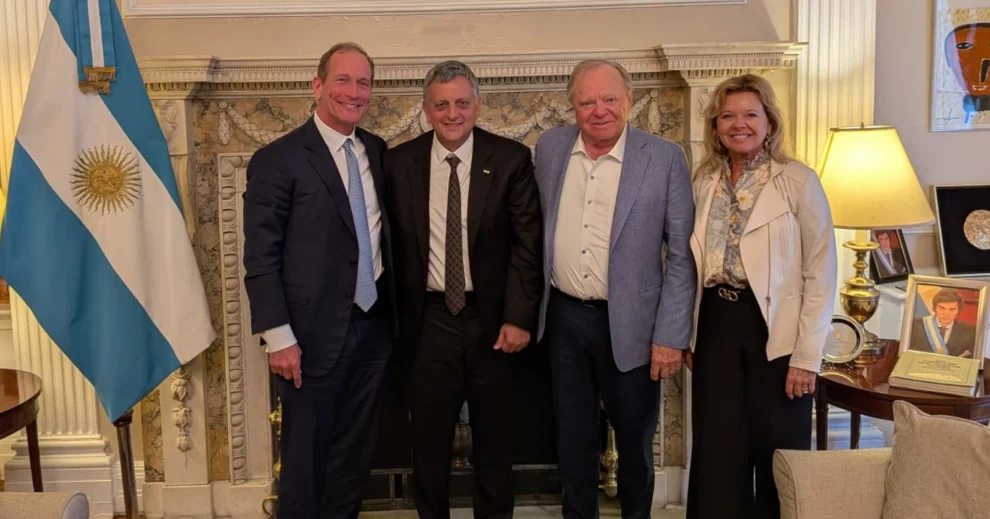
When Neuquén Governor Rolando Figueroa and Harold Hamm, Continental Resources' founder, met in New York in March at Bank of America's Argentina Week — an annual investor forum focused on Argentina's energy and macroeconomic outlook — Hamm arrived with a short list. Continental had entered the Vaca Muerta formation in late 2025 by acquiring 90% of the Los Toldos II Oeste block from Pluspetrol, an Argentine independent oil and gas producer, with GyP retaining the remaining 10% and Continental as operator.
But Hamm wanted more. According to Medele's account, Continental asked for access to "two or three" additional concessions in zones that had not previously been on offer, specifically because they lacked evacuation capacity.
The provincial response was twofold. First, the province would proceed with the public tender that Argentina's Bases Law requires for new concessions. Second, the midstream for those areas was already being contracted.
A calendar pulled forward two years
The 15 blocks are drawn from a larger universe. GyP reports on its institutional site that it holds 74 areas available for potential partnerships with investors, in addition to 14 non-conventional production concessions already granted and 24 active joint-venture contracts with private operators.
The provincial company, created on May 16, 2008 by decree 770/08, produced an average of 9,898.65 barrels of oil equivalent per day (boe/d) in December 2025. Its shareholder structure is fully public: 90% held by the Province of Neuquén and 10% by Hidrocarburos del Neuquén S.A. (Hidenesa). Guillermo Savasta has served as president and general manager since January 2024. In every new non-conventional concession, GyP retains a 10% stake.
The blocks in the first tranche were selected in two hubs: the central hub anchored in Añelo, and the northern hub in the Rincón de los Sauces–Auca Mahuida corridor. All sit within the liquids window and are surrounded by active fields. That is not incidental.
A block surrounded by producing developments comes with seismic data, offset well data, and known type curves — a type well being a statistical composite representing expected production performance for a given zone. The buyer does not acquire pure exploratory acreage. It acquires a starting point with residual geological risk.
The choice of the northern hub is not merely logistical. The liquids window along the Rincón de los Sauces–Auca Mahuida corridor combines a saturated section thicker than 150 meters, a geothermal gradient that keeps crude above 30° API, and a pore pressure that reduces the need for early artificial lift. That combination allows the northern hub to approach the yields of the Permian Basin's Delaware sub-basin at roughly two-thirds of the capex per well. Until six months ago, the constraint was takeaway, not rock.
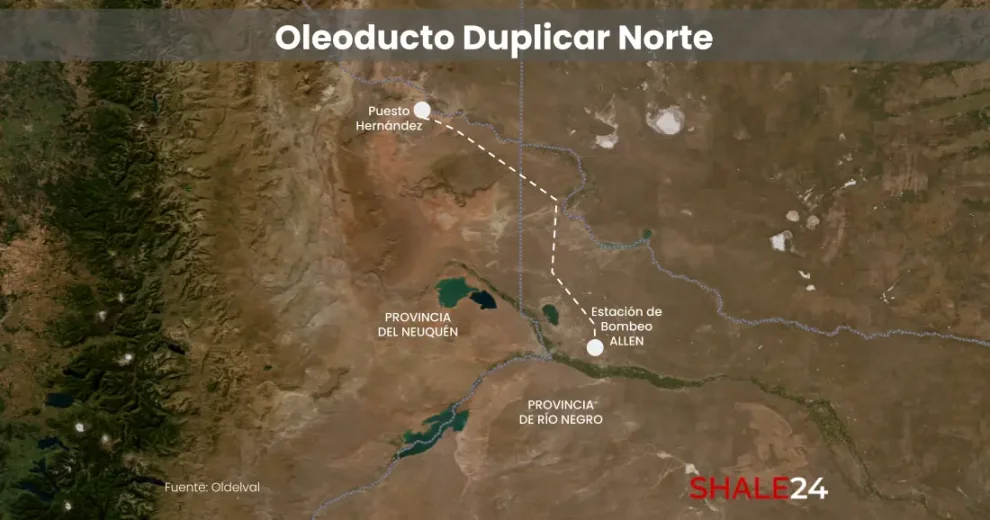
Duplicar Norte, the piece that enables the tender
The element that makes the August tender operationally viable is a project still under construction. Duplicar Norte, the Oldelval pipeline connecting the Auca Mahuida pumping station with Allen — a pipeline hub in Río Negro province where Oldelval's trunk system delivers crude for onward transport to the Atlantic coast — is 207 kilometers long, 24 inches in diameter, and involves an estimated investment of $380 million to $400 million.
It is being built under a ship-or-pay structure signed with four shippers: Chevron, the U.S. energy major; Tecpetrol, the Techint Group's exploration and production subsidiary; Pluspetrol; and GyP itself. Oldelval, the Vaca Muerta crude oil pipeline operator, joined the RIGI through a dedicated subsidiary, Oleoductos del Valle SDE, active since March 1, 2026.
The pipeline's schedule explains the tender. Early startup is scheduled for December 2026. Full operation is planned for March 2027. Initial capacity of 220,000 bbl/d will be expanded in stages to 300,000 bbl/d and eventually to 500,000 bbl/d. Those are the barrels that enable production from the northern-hub areas — the same corridor where several of GyP's 15 blocks sit. The province is tendering blocks whose evacuation already has a midstream contract signed, with its own state-owned company as a shipper. The alignment of dates is the argument.
The appetite behind it
Medele is explicit about the target: several Permian independents are seeing the horizon for adding reserves at home narrow and are looking for an international replacement, he argued in a mid-April interview. Continental Resources is the operational precedent: it entered through the Pluspetrol asset purchase and, earlier, had partnered with Pan American Energy (PAE), Argentina's largest private oil producer, to accelerate the development of joint areas. Hamm has already described Vaca Muerta as Continental's fifth global core asset.
The outside reading of the market aligns with the provincial one. In its early-year analysis of the themes shaping the 2026 international M&A narrative, Rystad Energy, the energy research and consultancy firm, identified growing interest in Argentina's Vaca Muerta shale as one of the year's central axes, placing it alongside Lukoil's international divestment, Santos's corporate sale process, and the expansion plans of Asian national oil companies. Read differently: Continental's appetite is not idiosyncratic. Other mid-size U.S. producers facing a shorter runway on domestic acreage are lining up behind it.

What the tender documents have not yet disclosed
Several critical elements will only be defined in May. The nominative list of the 15 blocks has not been released. The Ministry of Energy declined to confirm the specific identity of each block in response to questions, according to the first press coverage. Nor have entry fees, signing bonuses, minimum investment or drilling commitments, or eventual treatment under the RIGI or under Neuquén's provincial incentive regime been made public.
The most likely contractual model follows the GyP template established by the Los Toldos II Oeste case: a joint venture with the operator at 90% and the provincial company at 10%.
That systematic return of the 10% stake to the provincial treasury, combined with royalties paid to Neuquén province — the standard allocation under Argentine hydrocarbon law, since subsoil resources are owned by the producing province rather than the federal government — and with farm-in payments on subsequent farm-out operations, is what converts GyP into a sovereign M&A vehicle that does not sacrifice control for investment. The August tender formalizes that doctrine. The complete list of operators who will test it will be known when the sealed bids are opened. Roughly 90 days later.