
CERAWeek 2026
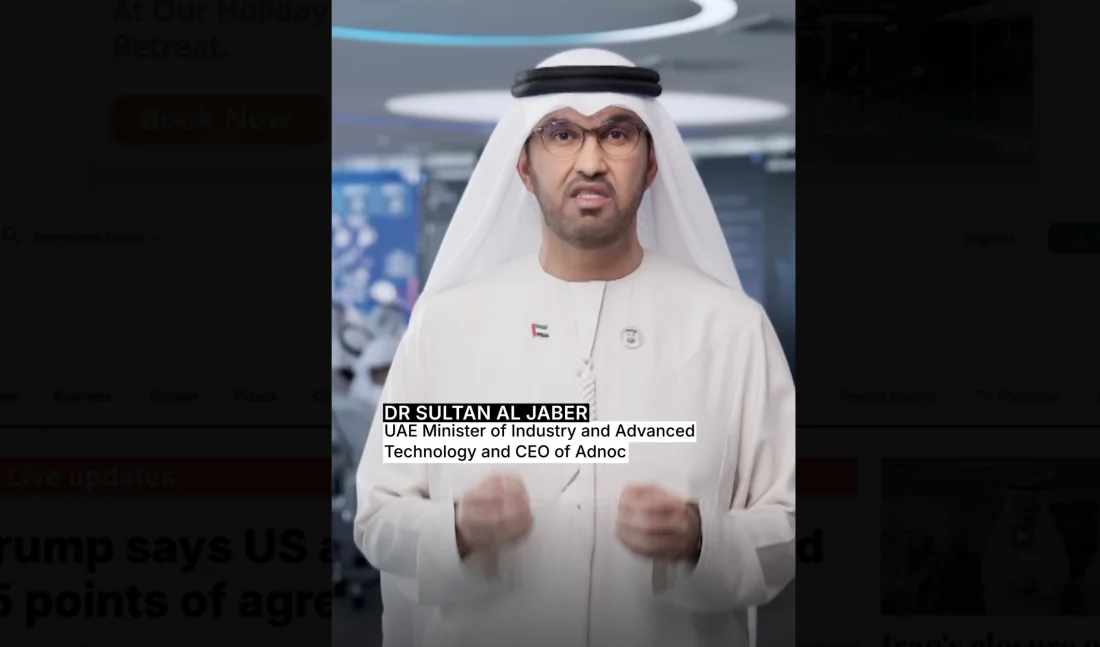
The line that will define CERAWeek 2026 did not come from a U.S. official or a Wall Street analyst. It came from Abu Dhabi.
"Twenty-one miles wide. Twenty million barrels a day. Nearly a fifth of the world's oil and gas," said Sultan Ahmed Al Jaber, UAE Minister of Industry and Advanced Technology and Managing Director and Group CEO of ADNOC, Abu Dhabi's state oil company, in a virtual address to the conference. "Energy security is not just a slogan. It's the difference between lights on and lights off."
He then sharpened his argument: "Weaponizing the Strait of Hormuz is not an act of aggression against one nation. It is economic terrorism against every nation. And no country should be allowed to hold Hormuz hostage — not now, not ever."
Al Jaber participated virtually — his physical presence impossible given what ADNOC had faced on the ground. "At ADNOC, we took hits no civilian enterprise, let alone one focused on delivering energy to the world, should ever have to take," he said. "We will continue to defend our nation and our way of life. In fact, this experience has only reinforced our model of pragmatic progress, rooted in realism not ideology, steady in its course, practical in its approach and relentlessly focused on results." He closed with a call that left no room for neutrality: "You can choose to be an architect of stability or a spectator to volatility."
The Empty Chairs: The Signal No One Missed
Al Jaber's virtual participation was itself a signal. But the most eloquent measure of the crisis's severity was not what was said in Houston — it was who did not show up.
Saudi Aramco chief executive Amin Nasser canceled his in-person participation and will not send a recorded message. Nasser is typically one of CERAWeek's headline speakers. His decision to remain in Riyadh reflects the scale of the operational challenge he faces: with the Strait closed, Aramco voluntarily curtailed output by approximately 2 million barrels per day across two fields — crude with no market access had nowhere to go — and is now routing the remainder from its eastern coast to its western coast to load tankers at the Red Sea port of Yanbu, where Saudi Arabia's East-West Pipeline terminates and which has become the kingdom's only functioning crude export outlet.
Yanbu itself came under attack on March 19: a drone struck the SAMREF refinery — the Saudi Aramco Mobil Refinery Company, Aramco's 50-50 joint venture with ExxonMobil at the port, which processes more than 400,000 barrels per day of Arabian Light crude — while Saudi air defenses simultaneously intercepted a ballistic missile aimed at the port. Damage was limited, but the message was unambiguous: the kingdom's only functioning export alternative is also within range.
The chief executive of Kuwait Petroleum Corporation, Kuwait's state oil company, also did not attend in person and will participate virtually in a Tuesday session.
The absences did not go unnoticed on the conference floor. When the CEOs of the world's largest producers cannot leave their facilities to attend the industry's most important annual gathering, the event becomes something different from what it was built to be.
Wright: "Temporary" — and Challenged
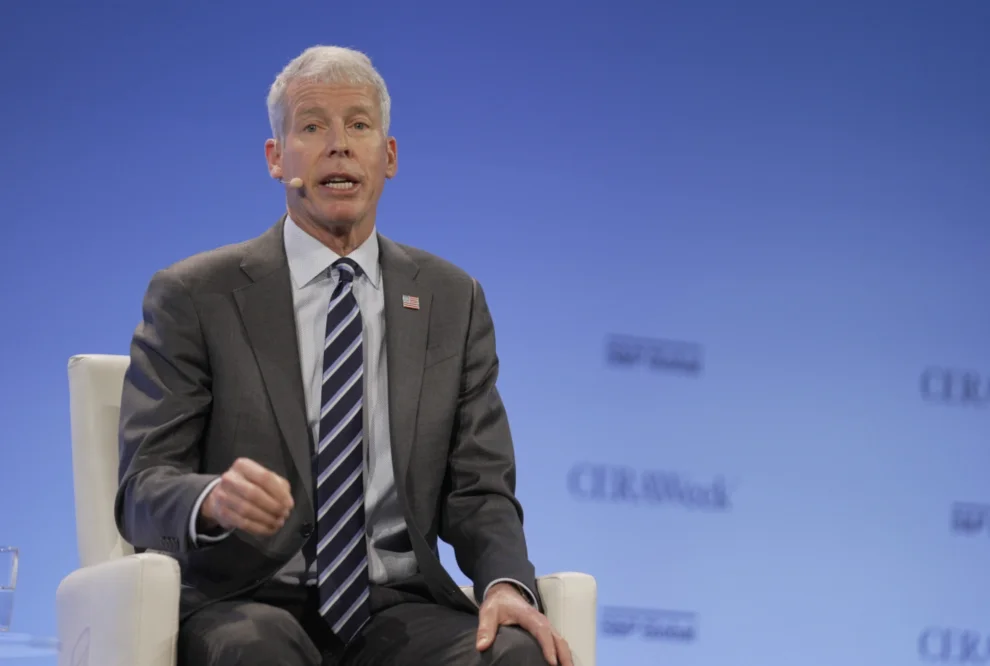
U.S. Energy Secretary Chris Wright opened the Executive Conference with a message calibrated to project control. "Obviously we have impacted energy flows and other critical material flows out of the Strait of Hormuz … But this is a conflict that we simply couldn't kick down the road," he said. Prices, he added, "have not risen high enough yet to drive meaningful demand destruction."
The U.S. Department of Energy announced the release of 172 million barrels from the Strategic Petroleum Reserve — the U.S. government's emergency crude stockpile, which can release up to 4.4 million barrels per day — as part of a coordinated International Energy Agency (IEA) response totaling 400 million barrels, approximately four days of global consumption, with a first U.S. tranche of 45.2 million barrels already flowing as of Friday.
Wright's framing — the crisis as "temporary" — did not land uniformly. U.S. gasoline averaged $3.84 per gallon at the close of last week, according to the American Automobile Association (AAA), the highest level in more than two years. Wright faced the simultaneous challenge of persuading major oil company CEOs to accelerate drilling against shareholder pressure, while explaining why a temporary sanctions waiver on Iranian crude already at sea does not contradict Washington's military objectives. It is a difficult argument to hold from both ends.
Markets offered a partial reprieve on Monday: Brent fell more than 8% after Trump announced a five-day postponement of threatened strikes against Iranian power infrastructure. Iran's foreign ministry denied, per Reuters, that any negotiations were underway.
Goldman: This Lasts Longer Than Anyone Wants
The day's most consequential number did not come from a stage. Goldman Sachs raised its 2026 Brent forecast to an average of $85 per barrel — up from $77 — and its West Texas Intermediate (WTI) forecast to $79 from $72, describing the Hormuz collapse as the largest supply shock in the history of the global oil market. The revision, authored by analyst Daan Struyven and published Sunday, March 22, assumes flows through the Strait will hold at just 5% of normal levels for six weeks, followed by a gradual one-month recovery.
In a severe adverse scenario — sustained production losses across the Middle East with no near-term resolution — Brent could stabilize around $115 toward year-end. If the blockade holds indefinitely, daily prices would surpass the all-time crude record set in 2008.
Analysts at the conference noted that Iran's cost of sustaining pressure is asymmetrically low: the Strait does not need to be physically closed — maintaining threat levels high enough that shipping companies will not route vessels through achieves the same result. A five-day pause does not change that calculus.
Qatar: A Gas Crisis on Top of the Oil Shock
One dimension of the crisis that received less attention on Monday — but may prove equally consequential: Iranian strikes on March 18 and 19 damaged the liquefied natural gas (LNG) complex at Ras Laffan, Qatar's dedicated LNG industrial city and export hub on the northeastern coast. Saad al-Kaabi, Qatar's Minister of State for Energy Affairs and president and chief executive of QatarEnergy, the Qatari state energy company, confirmed to Reuters that 17% of the country's LNG export capacity will be offline — with repairs estimated at three to five years. The damaged trains are operated jointly with ExxonMobil.
Qatar supplies approximately 20% of global LNG — including roughly 20% of Europe's supply and a significant share of Asian spot demand — and has now declared force majeure on its long-term contracts with buyers in Italy, South Korea, China, and Belgium. The disruption is structural: the markets that depended on those volumes face a supply gap through the end of the decade, with no comparable replacement capacity available before projects currently under construction come online in the early 2030s.
What This Sets Up
CERAWeek 2026 opened with the world's largest producers either absent or connected from hardened virtual positions, the senior U.S. energy official attempting to hold a contradictory policy together, and the day's most forceful statement delivered by a Gulf executive who framed the Hormuz closure as an act of economic warfare against the entire global economy. The five-day pause Trump announced may narrow the path to de-escalation — or simply compress the timeline to the next decision point. Either way, the supply gap, the price trajectory, and the question of whether Hormuz reopens through negotiation or by force will not be resolved inside this convention center.