
One of Vaca Muerta's largest shale gas producers

Techint Group chairman Paolo Rocca used his appearance at CERAWeek — the annual global energy conference organized by S&P Global, held this year in Houston — to put a number on what artificial intelligence could mean for Vaca Muerta: a recovery factor improvement from roughly 5% to 7% of original oil in place — a two-point shift that, by Shale24's estimates, would add approximately 3.3 billion barrels to the formation's recoverable resource base and roughly $230 billion in potential subsurface value. The data point went largely unreported in coverage of the conference.
Rocca argued that the industry currently extracts perhaps 5% to 6% of the actual resources in the Vaca Muerta formation through hydraulic fracturing — already valuable, he said — but that applying artificial intelligence across all operational variables could push recovery toward 7%, a shift he described as enormous, one that would change all the reference values for the formation's worth.
Rocca also addressed geopolitical fragmentation, broken supply chains, and the Techint Group's deepening bet on Argentina's oil and LNG ambitions — but it was the recovery factor question, delivered with the composure of someone who has watched the sector from the inside for decades, that carried the most consequential arithmetic. Rocca chairs Techint Group, the Argentine-Italian industrial conglomerate whose energy arm, Tecpetrol, is one of Vaca Muerta's largest shale gas producers.
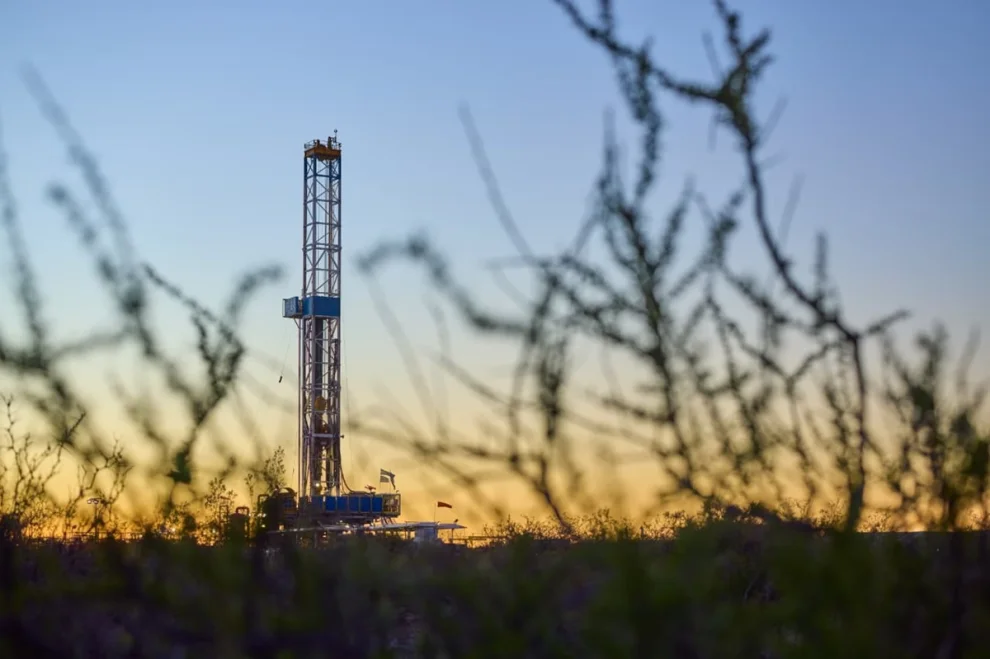
Why Recovery Factor Rewrites the Arithmetic
In a conventional reservoir, the recovery factor — the percentage of hydrocarbons in place that can be extracted with available technology — can reach 40% to 60%. In shale, the geometry of the problem is fundamentally different: oil and gas are trapped in tight, low-permeability micropores that hydraulic fracturing can only partially open. Operators extract a small fraction of what is in the ground, and that fraction defines everything else.
The U.S. Energy Information Administration (EIA) used a 5.6% recovery factor to calculate Argentina's technically recoverable shale oil resources — a figure that aligns precisely with what Rocca described as the current norm. The Vaca Muerta formation — one of the world's largest shale plays, located in Argentina's Neuquén Basin — holds technically recoverable resources of approximately 16 billion barrels of oil and condensate on that basis, according to the EIA.
Shale24 estimates, based on EIA parameters for original oil in place in the Neuquén Basin — then placed at approximately 331 billion barrels — that raising the recovery factor by one additional percentage point would add on the order of 3.3 billion recoverable barrels. At current benchmark crude prices, that incremental volume represents approximately $230 billion in potential subsurface value. The figures are Shale24's own calculations and are indicative; they depend on base assumptions. But they frame the scale Rocca was describing when he said it would change all the values.
AI in Shale: Operational Gains Now, Recovery Factor Later
Rocca was measured in his own assessment, noting that companies in the U.S. are already developing AI applications for shale, drawing on enormous volumes of data to better understand how to extract value. The sector, he said, is moving from using AI as a source of information toward having it make decisions directly — with small projects underway but no conclusive results yet, and significant ongoing experimentation.
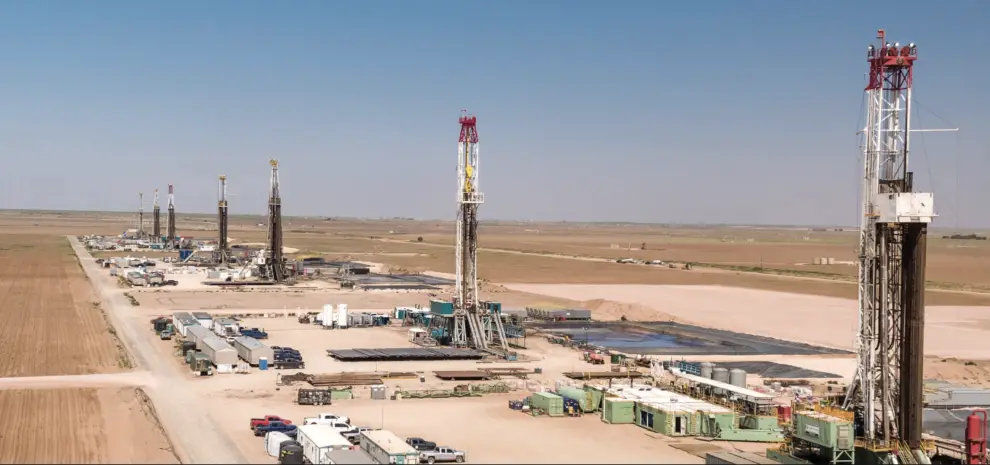
In the Permian Basin, West Texas's prolific shale oil-producing region, operators including ExxonMobil, the U.S. energy major, and Baker Hughes, a U.S. oilfield services company specializing in digital and AI-driven well optimization, are applying AI to optimize gas lift in real time, predict equipment failures, and improve hydraulic fracture design. In January 2026, the Journal of Petroleum Technology (JPT), the Society of Petroleum Engineers' flagship technical publication, described the Permian as a basin in transition: from aggressive expansion toward sustained efficiency, with fewer new wells and smarter extraction from existing assets. AI, alongside Enhanced Oil Recovery (EOR) techniques and new well geometries, is driving that shift.
In Vaca Muerta, the curve is just beginning. Current applications are concentrated in predictive maintenance, remote drone monitoring, and cloud-based integrated control dashboards. YPF, Argentina's state-controlled oil and gas company, inaugurated an AI-enabled operations center at its Plaza Huincul refinery — located in Neuquén province, at the heart of the Vaca Muerta operating zone — in December 2025. The broader constraint is structural: Vaca Muerta's development, though accelerating sharply since 2022 under improved regulatory and fiscal conditions, remains at an earlier stage of data density than the Permian Basin, which has more than a decade of high-cadence pad drilling and sensor integration at scale.
AI oriented toward modifying recovery factors — the horizon Rocca outlined — has no at-scale applications in the Argentine basin yet. The core obstacle identified by sector analysts is data fragmentation: without integration of well, sensor, and production data at scale, machine-learning models cannot accumulate sufficient knowledge to optimize extraction.
The Underlying Thesis
What Rocca put forward in Houston was not an announcement. It was a long-term proposition, delivered before a global audience of executives, investors, and technologists. The argument holds that shale — a formation that today leaves 94% of its resources below the surface — can improve that equation with data and algorithms, and that Argentina, with the world's second-largest shale gas reserves and the fourth-largest unconventional shale oil reserves, has sufficient scale for that improvement to matter.
The fact that conclusive results have not yet arrived, as Rocca himself acknowledged, does not diminish the weight of the question. In shale, two percentage points of difference in recovery factor are not a technical adjustment. They are another field.