
Power

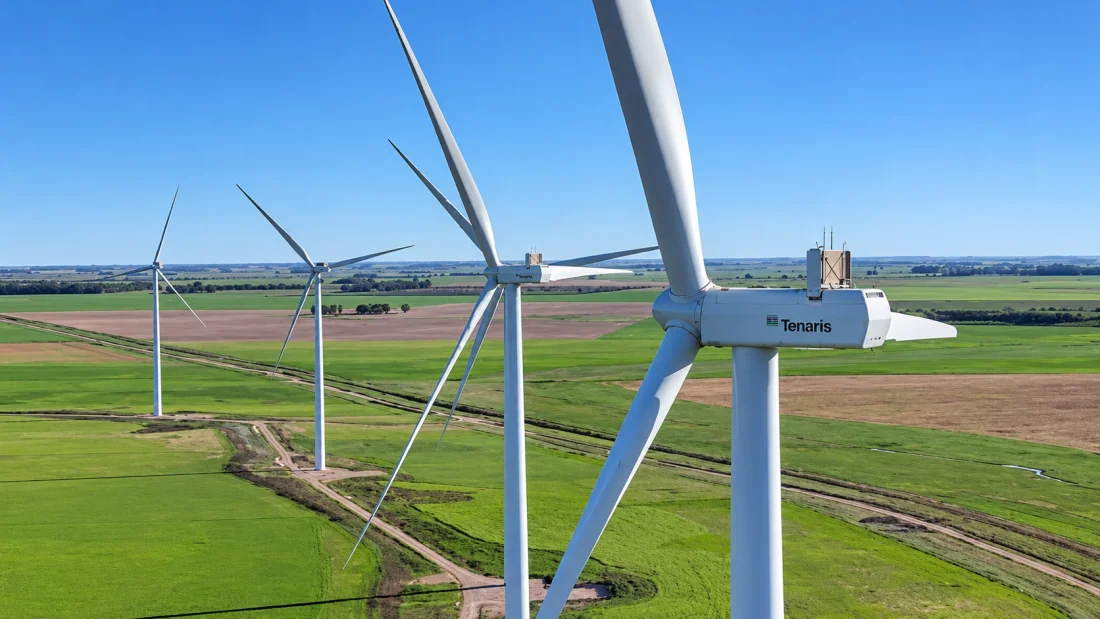
Argentina's Ministry of Economy approved the entry of the La Rinconada Wind Farm into the Large Investment Incentive Regime (RIGI). The 94.5-megawatt (MW) project is being developed by Vientos La Rinconada 40 kilometers from Olavarría, Buenos Aires province, to supply the production process at Siderca, the seamless pipe plant that Tenaris, the Techint Group's steel pipe maker, operates in Campana.
The project carries a total declared investment of $230.75 million, of which $218.29 million corresponds to computable assets. The plan the company submitted front-loads the effort: it declares $110.63 million in computable investment for the first year and $1.43 million for the second. Within the 15% cap the law allows for certain payments, the company reported $13.22 million for usufruct rights over the land.
The resolution sets March 31, 2027 as the deadline to complete the minimum investment in computable assets. That date is a RIGI compliance milestone and is separate from the wind farm's commercial start-up. In addition, during the first two years from notification, the company must demonstrate at least 40% of the minimum investment set for the energy sector.
The project is Tenaris' second wind farm in Argentina. When it announced the start of assembly, the company reported 21 turbines of 4.5 MW each and an investment then estimated at $214 million, with Techint Engineering & Construction managing the work. "We estimate that the La Rinconada wind farm will allow us to reduce CO₂ emissions by about 100,000 tons per year," Andrea Previtali, Tenaris' president for the Southern Cone, said at the time. Together with the Buena Ventura Wind Farm in Gonzales Chaves, Buenos Aires province, it will supply the power consumption of the Campana Industrial Center.
The Wind Farm Connects to the Grid Through a New TRANSBA Substation
According to the resolution, CAMMESA, the Argentine wholesale electricity market administrator, granted the project dispatch priority of 91.5 MW under the "Referencial A" mode. The connection to the Argentine Interconnection System (SADI) runs through the new La China Transformer Station, owned by TRANSBA, the Buenos Aires province trunk transmission company, and located on the site of the Viento de Olavarría Wind Farm, next to La Rinconada.

The electricity file has its own history. In November 2024, Resolution 327/2024 of Argentina's Secretariat of Energy authorized Vientos La Rinconada to join the Wholesale Electricity Market (MEM) as a generating agent, with capacity of 92.4 MW and a 132-kilovolt connection on the Henderson-Olavarría line.
The destination of the power shapes the rest of the profile. Because the wind farm will supply Siderca, the company declared no exports and did not request the free availability of foreign currency, the RIGI benefit that frees part of export proceeds from Argentina's foreign-exchange rules, under Article 198 of Law 27,742, the Bases Law. The Central Bank raised no objections on the foreign-exchange aspects. To measure the project's contribution, the Undersecretariat of Electric Energy asked CAMMESA for a report on its impact on the wholesale market's annual foreign-currency requirements through substitution of energy and fuel imports.
Olavarría Now Hosts Two RIGI Wind Farms Built for Steelmakers
With this approval, the Olavarría district adds a second RIGI wind farm dedicated to steelmaking. The first is the Olavarría Wind Farm of GEAR I, the company jointly owned by Petroquímica Comodoro Rivadavia (PCR) and ArcelorMittal Acindar, which entered the regime under Resolution 1254/2025 with a 180-MW plan to supply the steelmaker's plants. For Acindar, that wind farm is the piece with which it expects to exceed 65% renewable supply.

Both projects follow the same logic. Acindar framed its move as a decision to stop being just one of Argentina's largest electricity consumers and to control the generation that supplies its plants, and La Rinconada answers the same equation for the Campana steelworks. On the Tenaris side, La Rinconada completes a scheme the Techint Group has been assembling wind farm by wind farm since Buena Ventura.
Buenos Aires province already has experience with this kind of staged growth. In mid-year, PCR took the Mataco-San Jorge complex to 276.6 MW with six new turbines.
The Process Added the Foreign Ministry Check Required by Decree 868/2026
The application was filed on May 28, 2025. Along the way, the Undersecretariat of Electric Energy and the Secretariat for Energy and Mining Coordination sent eight requests for supplementary information, and the Treasury Attorney General's Office endorsed the arbitration clause the company proposed for resolving potential disputes.
The final stretch added a new requirement. Decree 868/2026 required prior review by the Ministry of Foreign Affairs to verify compliance with Law 26,659, which sets conditions for hydrocarbon exploration and production on the Argentine continental shelf, and the Foreign Ministry reported that neither the company nor any person with a direct or indirect stake in it had engaged in the conduct that law prohibits. Given the time elapsed, the Secretariat of Energy issued a supplementary technical report with an updated investment schedule.