
U.S. seeks to safeguard its energy future

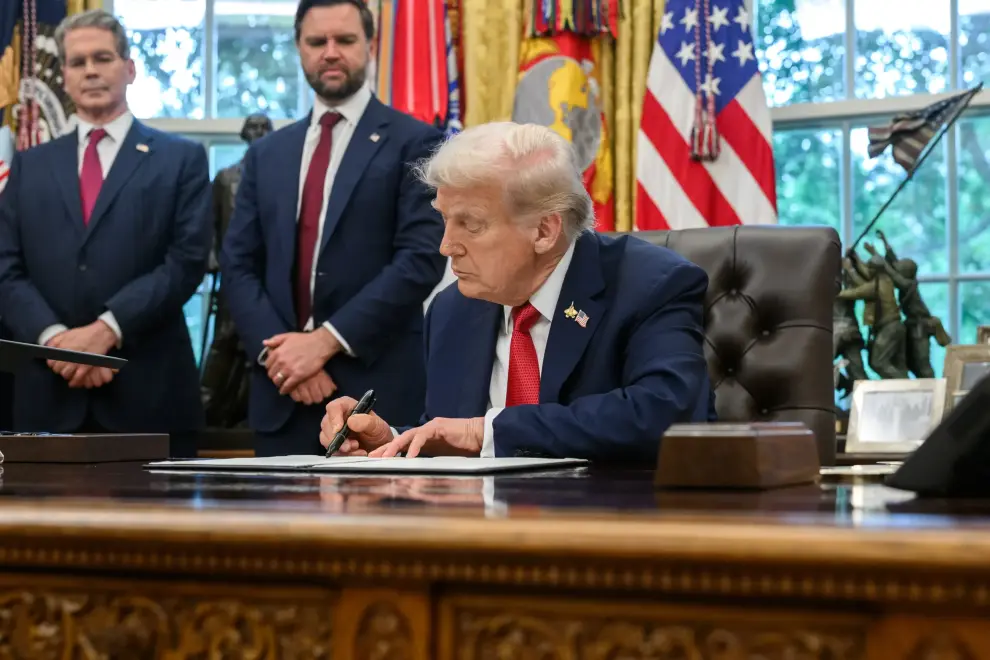
The Trump administration has launched Project Vault, a $12 billion initiative aimed at establishing the U.S. Strategic Critical Minerals Reserve, a public-private mechanism to stockpile essential minerals and mitigate risks in U.S. supply chains.
According to experts at Rystad Energy, the move marks a meaningful step forward, though insufficient on its own to break China’s dominance in the processing and supply of these strategic materials.
What Project Vault is about
The program, announced Feb. 2, combines a record $10 billion loan from the Export-Import Bank of the United States (EXIM)—the largest in its history—with roughly $2 billion in private investment. The reserve will operate in a decentralized manner, with secure facilities across U.S. territory, and will cover more than 50 minerals included on the U.S. Geological Survey’s 2025 critical minerals list, prioritizing rare earths, lithium, cobalt, copper, gallium, germanium and scandium.
Unlike the traditional National Defense Stockpile, which is focused on military uses, Project Vault prioritizes key civilian sectors such as electric vehicles, batteries, wind turbines, semiconductors and consumer electronics. President Donald Trump presented it as a mineral equivalent of the Strategic Petroleum Reserve, designed to protect companies and workers from supply disruptions or price volatility.
Jeff Dickerson, a principal advisor at Rystad Energy, described the measure as “one first step among many.” In recent analyses published in outlets such as Fortune, Dickerson stressed that overcoming China’s hegemony—which controls between 80% and 90% of global rare earth processing and dominates critical stages of other minerals—requires a coordinated, long-term effort comparable to a “wartime response.”
This includes not only building reserves but also expanding domestic production and partnerships with allied countries such as Australia, Canada and potentially nations in Central Asia. A stockpile can cushion short-term shocks but does not resolve the structural shortage of mining and refining capacity outside China.
Rystad Energy places Project Vault within the context of the accelerating energy transition. Demand for critical minerals is expected to grow exponentially—for example, lithium used in batteries could increase twelvefold by 2050—driven by electrification, renewables and clean technologies. Without effective diversification, geopolitical risks remain, including export restrictions from China such as those previously imposed on gallium and germanium.
The firm notes that initiatives like this, together with incentive policies and international forums, could attract private investment, stabilize prices and unlock projects that previously faced barriers due to dependence on Beijing.
Suppliers including Hartree Partners, Mercuria and Traxys are already participating, and the program aims to send firm demand signals to accelerate the development of resilient supply chains. However, analysts warn of sustainability challenges: success will depend on policy continuity beyond the current administration and coordinated execution integrating production, processing and recycling across Western economies.
Project Vault represents a strategic “America First” declaration on critical minerals, aligned with national security and energy transition objectives. As the market watches its early impacts, Rystad Energy emphasizes that true structural change will require years of sustained investment and global collaboration. The geopolitical clock is ticking, and the resilience of U.S. supply chains is at stake.