
Midstream

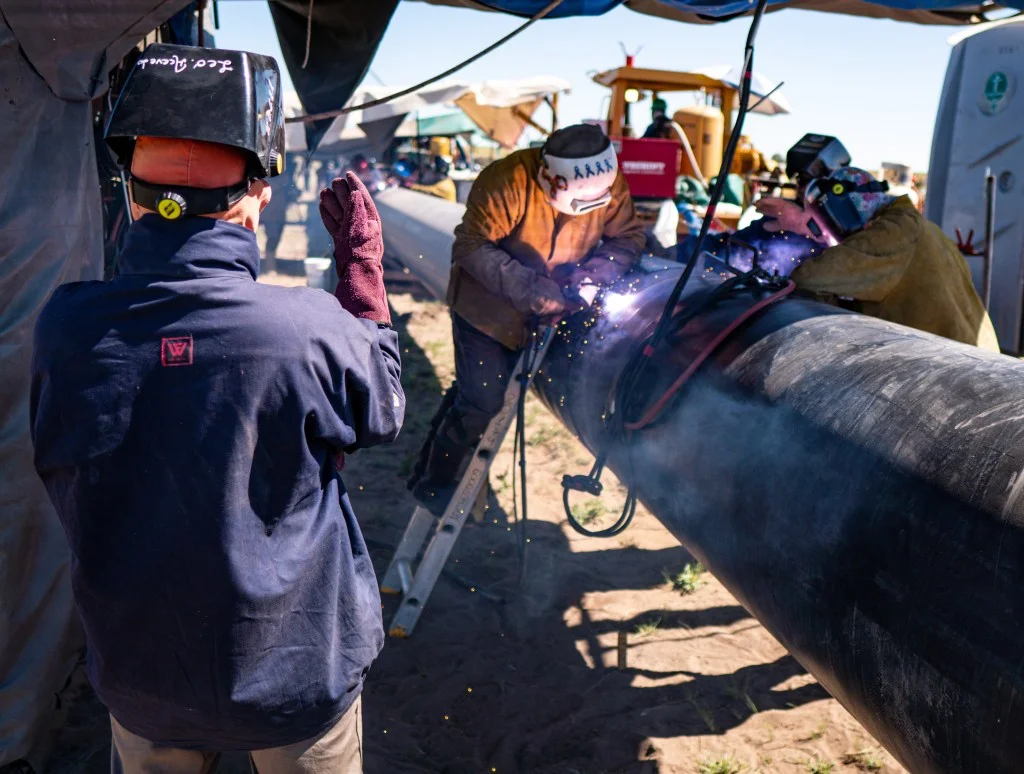
Oldelval will decide by early 2027 whether to build a second pipeline in northern Vaca Muerta, repower its Medanito pumping station, or both.
Duplicar Norte, the company's crude line serving the north of the play, has yet to move a barrel, and Oldelval, the Vaca Muerta crude oil pipeline operator, is already planning what comes next. Ricardo Hösel, chief executive of the company, which moves more than 80% of the Neuquén Basin's crude, confirmed the options in comments to Shale24: "We are studying a second pipeline or repowering the Medanito pumping station. Those are the two alternatives. It could also be both."
The timeline is tight. "We should define that by the end of this year, early next year. We should have it decided," Hösel said. He also set the condition that governs any midstream investment: "Obviously it will depend on the volume our customers request from us, and on seeing which project best fits that volume."
The two options are not equivalent. A second pipeline adds new pipe, with the investment and lead times of a project spanning hundreds of kilometers. Repowering a pumping station pushes more crude through the existing line, with less steel and less time, but a lower physical ceiling. That Oldelval is not ruling out both says something about the volumes it expects and the pace of the production ramp the industry is anticipating.
Hösel had opened the door a day earlier at the Oil&Gas Tech Forum organized by AHK Argentina, the German-Argentine Chamber of Industry and Commerce, for which Shale24 was media partner. He first addressed the project under construction: "We are building Duplicar Norte, which is already 60% complete and will add some 200,000 barrels of capacity." He then said the company was already "studying the possibility of building another pipeline parallel to this one, in that same area, because of the growth we are seeing over the next few years."

Shale24's follow-up filled in the picture: the parallel pipeline is one of two options on the table, the other is the Medanito station, and the decision has a date.
Northern Vaca Muerta Is the Next Growth Frontier
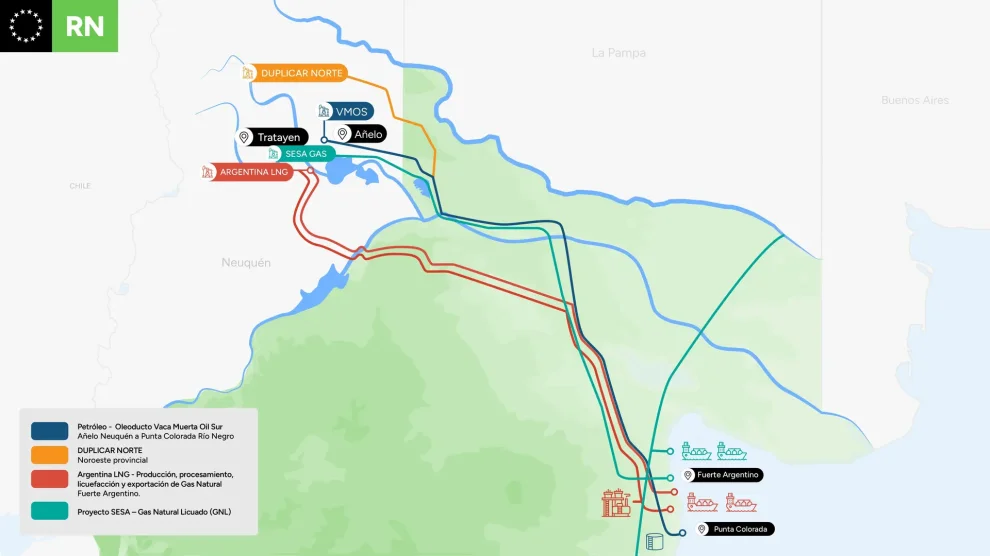
The underlying bet is geographic. "We believe, or rather we are certain, that the basin's next growth leap will come in northern Vaca Muerta, near Rincón de los Sauces," Hösel said, referring to the oil town in northern Neuquén province.
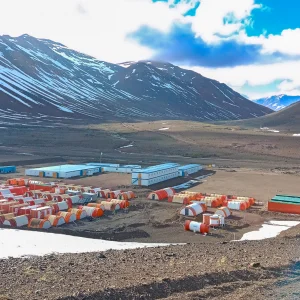
Duplicar Norte is the first response to that bet. The 207-km, 24-inch pipeline links the Puesto Hernández station in northern Neuquén province with Allen, a pipeline hub in Río Negro province and Oldelval's main pumping station. There, crude connects to the trunk line to Puerto Rosales, Buenos Aires province, Argentina's primary Atlantic crude export terminal, and to the head of the Vaca Muerta Oil Sur pipeline (VMOS) running to Punta Colorada. Hösel put a round number on the investment, "about $400 million," and the line is being built by Techint, as Shale24 reported in January.
The project was sold out before construction began. In July 2025, Oldelval signed ship-or-pay contracts, under which shippers pay for reserved capacity whether or not they use it, with Chevron, the U.S. energy major; Tecpetrol, the Techint Group's exploration and production subsidiary; Pluspetrol, an Argentine independent oil and gas producer; and Gas y Petróleo del Neuquén (GyP), Neuquén province's state oil and gas company. Two of those shippers have already secured approval under Argentina's Large Investment Incentive Regime (RIGI) for developments in the north of the formation: Tecpetrol at Los Toldos II Este, where it committed to 380 wells through 2054, and Pluspetrol at the Bajo del Choique–La Invernada block, a $12.4 billion project.
Those plans are, in effect, the demand Hösel expects to hear before deciding. If they materialize, Duplicar Norte's 200,000 barrels will fall short before the end of the decade.

Why Pipelines Must Now Be Built in Parallel
The urgency comes down to a calculation every pipeline operator in the basin carries in its head. At the forum, Hösel summed up recent history in two figures: in 2021 the Neuquén Basin produced 250,000 bbl/d; today it produces 750,000 bbl/d. Production tripled in five years, and what held it back at each stage was not the rock but the pipe.
In between came Duplicar Plus, the 525-km pipeline Oldelval commissioned in March 2025, an investment of more than $1.2 billion that added more than 300,000 bbl/d of capacity. "That project is already running at full capacity today," Hösel said. "In other words, Oldelval's pipelines are at full capacity again." To stretch the system until VMOS arrives, the company recently completed a repowering of its trunk line.
The problem is one of mismatched speeds. According to Hösel, when it has takeaway capacity, the basin can add 150,000 to 180,000 bbl/d of production each year. A large pipeline, by contrast, takes two to three years from investment decision to first barrel. At those rates, each expansion fills up faster than it took to build: Duplicar Plus took little more than a year to saturate, and Duplicar Norte's 200,000 bbl/d is equivalent to just over a year of basin growth.
The consequence is that in Vaca Muerta, pipelines are no longer built one after another but overlapping. The next project has to be decided while the previous one is still under construction, because waiting until the first fills means curtailing production for as long as the second takes to build. "When there was transport capacity, the basin was immediately able to grow to its maximum potential," Hösel said. The Medanito-or-second-pipeline decision applies that logic to the north before the bottleneck arrives.
VMOS, the Other Outlet
The other piece of the system is VMOS, whose 437-km trunk line runs from Allen to the Punta Colorada export terminal on the Golfo San Matías in Argentina's Río Negro province, a deepwater gulf suited to loading VLCCs. It has 550,000 bbl/d of contracted capacity and is scheduled to start up in early 2027. It is the project behind the step change in the basin's takeaway capacity, and the one that will give Duplicar Norte somewhere to discharge northern crude.
At the forum, Hösel also revised one of his own figures. In July, at the Shale24-Santander Energy Summit, he had put the basin's takeaway capacity once all projects are complete at more than 1.3 million bbl/d. He has now raised it to more than 1.4 million bbl/d.
The calculation starts from current capacity. "With the latest projects we completed, the Neuquén Basin has takeaway capacity of 900,000 barrels: 700,000 to the Atlantic and 200,000 to the Pacific and to the Luján de Cuyo refinery," he said, referring to YPF's refinery in Mendoza province. VMOS adds its 550,000 bbl/d of contracted capacity. Duplicar Norte, which Hösel said will be nearing completion by the end of the year, does not open a new route to the sea, but it carries northern crude to Allen, the station where both Oldelval's system and VMOS begin.
With that ceiling, Hösel ran the numbers in reverse. "I estimate that the basin, at that pace of 150,000 or 180,000 barrels it can grow per year, will have filled its crude takeaway capacity by 2030 or 2031." From today's 750,000 bbl/d, that is four to five years of growth at that rate.
Asked for a business outlook, Hösel switched from barrels to dollars. "We are going to reach that million and a half barrels by 2030 or 2031," he said. He recalled that in 2022 Argentina ran an energy trade deficit of $5 billion and that this year will close with a surplus of more than $7 billion. “In two years or so, we will be exporting $10 billion in crude alone.”