
Oil & Gas

YPF has freed up more than $1 billion in working capital in two years by applying Toyota's production system to well construction, chief executive Horacio Marín said.
Marín framed efficiency as a matter of survival for Vaca Muerta. The U.S. runs about 500 drilling rigs, he said. In Vaca Muerta, YPF, Argentina's state-controlled oil and gas company, operates more rigs than anyone else, and the next operator runs three or four. That scale gap gives U.S. producers better unit prices. "If we don't have productivity, we're done for," he told a packed audience at the Rosario Board of Trade, the exchange at the center of Argentina's grain export hub, on October 16.
Rig Count Headed to 30
YPF ended 2025 with 12 rigs in Vaca Muerta and runs 18 today. Marín confirmed the company will reach 21 in February and added a new step: 30 rigs next year. That is a jump from the guidance YPF gave analysts in August, when it spoke of holding 21 rigs active almost constantly throughout 2027. Marín first gave Shale24 the 18-rig and 21-rig figures in September.
The ramp-up coincides with two fronts opening almost in parallel. One is the start-up of the Vaca Muerta Oil Sur pipeline (VMOS), Argentina's new crude export line to the Atlantic coast, scheduled for January. The other is drilling to supply gas to Argentina LNG, which according to the project's application under Argentina's Large Investment Incentive Regime (RIGI) will require about $5 billion in upstream development before exports begin.
Marín insisted that geology alone is not enough to compete. Data from Rystad Energy, the Norway-based energy research firm, that he presented place Vaca Muerta above U.S. basins in cumulative production per well. Even so, breakeven prices come out "similar," because Argentina's smaller scale eats into its geological advantage. His conclusion: Argentina must always stay slightly more efficient than the U.S., because U.S. shale will set the market floor when crude prices fall.
Four Wells in 193 Days
YPF's answer to that disadvantage has a Japanese name. The Toyota Well program, an adaptation of the carmaker's production system to well construction, has been running for two years. Marín put numbers on the result: four wells that used to take YPF 312 days are now completed in 193, a 38% reduction.
The financial impact matters most. Across the full rig fleet, Marín said, the reduction cuts working capital by more than $1 billion, money the company no longer has tied up in half-finished wells.

The model requires a different relationship with contractors. Marín described it as a partnership: the service company proposes how to do the job, and YPF stops supervising it step by step. The rule is to split productivity gains equally with each contractor. "It's a huge cultural change," he acknowledged.
To explain why Vaca Muerta is viable today when it was not before, Marín drew on his own career. YPF's current wells reach about 3,000 meters in depth and run another 3,500 meters horizontally, spaced 250 to 300 meters from the neighboring well. Each carries, according to Marín, about 300 fractures. When he was 30 and working in Venezuela, a single fracture of that type cost $2.7 million. "Now that fracture costs us $170,000. That's the reason Vaca Muerta exists today," he said.
The other indicators point the same way:
- Fracturing speeds are 50% higher than when the current management took over.
- Using blocks such as Loma Campana and Bandurria Sur as examples, Marín said bringing a block to 50,000 bbl/d used to take YPF eight years and now takes 18 months.
- 95% of YPF's production now comes from Vaca Muerta. According to Marín, the cost difference versus the mature fields YPF sold adds $2 billion in additional profit per year.
- YPF's inventory exceeds 10,000 wells to be drilled, representing more than $150 billion in investment. On that basis, Marín said, YPF ranks as the world's sixth-largest company by unconventional drilling locations, U.S. companies included.
Recent activity already shows in official data: 40 new wells accounted for all of YPF's August production growth at Bandurria Sur, Loma Campana and La Angostura Sur I, as Shale24 reported.
Same Playbook Downstream
The productivity drive has also reached refining and marketing, and Marín backed it with figures:
- YPF's refining throughput rose from 280,000 to 345,000 bbl/d, above nameplate capacity and without major investment, Marín said. He singled out La Plata, Argentina's largest refinery, which he said was "losing money" when he took over.
- Service stations running out of fuel on a given day fell from 246 to 6, across a network of 1,750.
- The accounting close, which took 40 days, now happens on the seventh business day and will move to the fifth in December.
Leverage is following. Net debt stands at 1.1 times EBITDA and, Marín said, will fall further in third-quarter results, which YPF reports on October 29.
Argentina LNG, Five Weeks Before FID
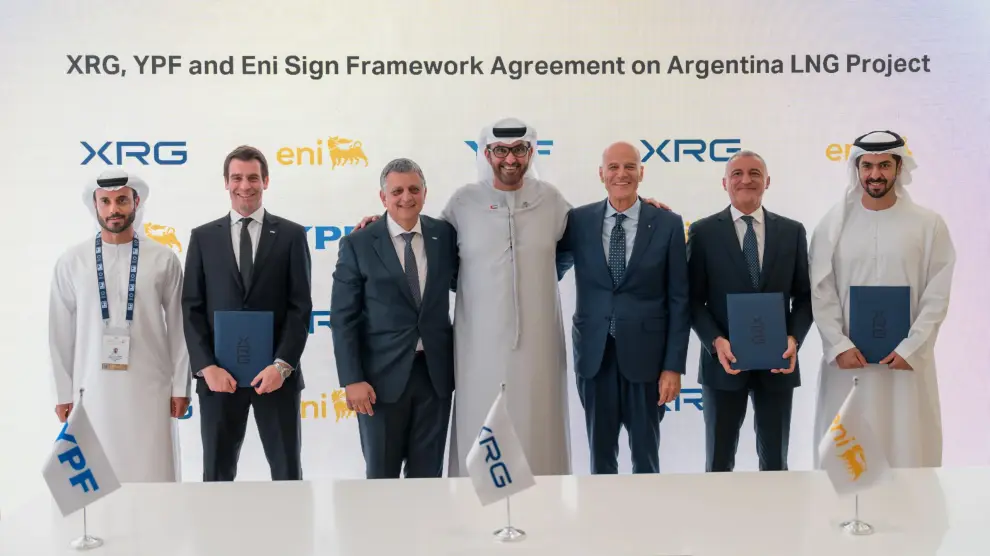
Upstream productivity underpins YPF's biggest bet. "The LNG project is the hardest thing I've had to do in my life," Marín said before detailing the numbers for Argentina LNG, which YPF is developing with Eni, the Italian energy company, and XRG, ADNOC's international investment arm.
Marín started from the $51 billion in the project's RIGI application and said: "We're going to go to 76,000." He later broke the figure down: total investment is $51 billion, and operating costs exceed $25 billion. The spending required before the first cargo ships is about $30 billion over four years: $24 billion in infrastructure (pipelines, processing plants, port facilities and liquefaction units) and $5 billion in wells.
The first phase will deploy two floating LNG (FLNG) units with combined capacity of 12 million tonnes per annum (MTPA). A third unit would add another 6 MTPA, an expansion Eni chief executive Claudio Descalzi already factors into his numbers. According to a project video YPF showed, that would make YPF the world's sixth-largest LNG exporter and the second-largest ethane exporter.
Marín also broke down the $20 billion in gas exports he usually cites as a round number:
- Southern Energy, the FLNG consortium led by Pan American Energy (PAE), Argentina's largest private oil producer, with 6 MTPA: about $2.5 billion a year.
- Argentina LNG's two units: about $10 billion.
- The 6 MTPA expansion: another $5 billion.
The total comes to about $17.5 billion. "We have everything sold," Marín said of the output. The final investment decision (FID) is set to be signed on November 26 in Buenos Aires, he said.
His closing argument to the Rosario audience went beyond exports. Vaca Muerta's oil comes with large volumes of associated gas that has no export outlet. That gas will be sold cheaply in the domestic market, as happened in the U.S. For local industry, Marín promised "the cheapest energy in the world."