
E&P INVESTMENT


Argentina has admitted Tecpetrol's $6.43 billion Los Toldos II Este shale oil project into the RIGI, approving a 380-well, three-stage development plan running through 2054.
Argentina's Official Gazette published Resolution 1771/2026 of the Economy Ministry on Oct. 9, approving the project as a Strategic Long-Term Export Project (PEELP) under Argentina's Large Investment Incentive Regime (RIGI). The vehicle is a joint venture between Tecpetrol, the Techint Group's exploration and production subsidiary, and Gas y Petróleo del Neuquén (GyP), Neuquen province's state oil and gas company.
The block lies in the Vaca Muerta formation, one of the world's largest shale plays, and the project is the largest oil production development approved under the regime, as Shale24 reported in August.
Seven weeks passed between the evaluation committee's recommendation and the signature. Minutes No. 27 of the RIGI Evaluation Committee, dated Aug. 20, had recommended approval, and the announcement followed that month. Behind the round August figure lie a staged schedule, a dated investment commitment and a filing that had to be amended late in the process.
Three Stages, 380 Wells
The block covers 78 km² in the Pehuenches department of Neuquen province, in the northern part of the Neuquen Basin known locally as the Engolfamiento, or Bajo de Anelo. The plan calls for 380 horizontal wells, drilled from four-well pads with laterals averaging 2,700 meters.

The joint venture declared three stages, each above the $1 billion per-stage floor the regime sets for PEELP projects:
- Stage 1 (Nov. 1, 2024, to Feb. 28, 2027): $1.635 billion. Covers infrastructure (central processing plant, oil and gas pipelines) and 16 wells.
- Stage 2 (March 1, 2027, to June 30, 2029): $1.268 billion. Expands the plant to 70,000 bbl/d and adds 91 wells.
- Stage 3 (July 1, 2029, to 2054): $3.529 billion. Completes the remaining 273 wells and the facilities for full-field development.
The total is $6.432 billion. More than half of the investment and seven in ten wells come after mid-2029, over a 25-year horizon. Stage 1 commits $1.635 billion to just 16 wells because that is when the surface infrastructure is built, which later makes the rest of the field pay off.
A Plant Open to Third Parties
Surface infrastructure is the core of that first stage.
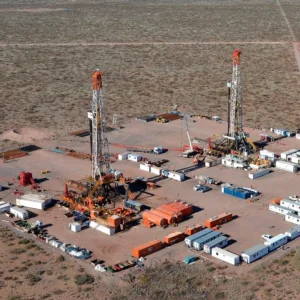
The resolution describes a Central Processing Facility (CPF) with projected capacity of 70,000 barrels per day (bbl/d) of oil and 3.6 million standard cubic meters per day of gas, an oil export pipeline, a gas pipeline for associated gas, water supply, gathering and reinjection systems, power infrastructure, roads and camps.
The approved scope includes a detail the August announcement did not show.
Article 1 covers "the development, operation and/or provision of the treatment, processing, storage and transportation service" for oil, natural gas and water produced from the area "and/or provided to third parties," along with the construction and operation of plants, oil pipelines and gas pipelines. The plant is not tied solely to Los Toldos II Este wells.
On measurement, the resolution finds that the venture's scheme, based on back allocation and multiphase meters, is "technically consistent" with standard methodologies and allows production attributable to the project to be identified, segregated and audited "in principle." If the plant processes third-party output, that separation determines which barrels receive the regime's benefits.
The Foreign Ministry Screening
The filing was amended late in the process. The committee had already recommended approval when Decree 868/2026, issued on Sept. 3, added a new requirement to every RIGI application: a sworn statement of compliance with Law 26,659, which penalizes unauthorized hydrocarbon activity on Argentina's continental shelf, and a prior, mandatory review by the Foreign Ministry, designated as the enforcement authority. The law targets companies operating in the waters around the Falkland Islands (Malvinas), whose sovereignty Argentina disputes with the United Kingdom.
The resolution records that step. On Sept. 9, "as a result of the issuance of Decree 868/2026," the venture filed amended documentation for its Aug. 18 application. The Foreign Ministry concluded that, as of the date of its communication, there was no indication that the vehicle or any person with a direct or indirect interest in it had engaged in the conduct prohibited by Article 2 of that law. The adhesion date set in Article 2 of the resolution matches that filing: Sept. 9, 2026.
The other reviews raised no objections. Argentina's central bank (BCRA), the Treasury Attorney General's Office and the National Competition Authority, through its Competition Defense Tribunal, issued approvals and opinions with no objections to the application. Argentina's Secretariat of Energy found in its technical report that the project meets the regime's requirements and objectives. The venture plans to use the foreign exchange benefits of Article 198 of Law 27,742, the Bases Law, and submitted a supplier development plan.
What the Venture Must Show by Aug. 31, 2027
The operative section sets deadlines. Article 3 requires the venture to demonstrate, within the first two years from notification, investment in eligible assets of at least 20% of the category's minimum amount. Article 4 sets Aug. 31, 2027 as the deadline to meet the PEELP minimum.
The venture has ample headroom. It declared $1.182 billion in eligible investment for the first year and $578 million for the second, $1.76 billion in total, against a floor of $400 million (20% of the $2 billion required of a PEELP). That is 4.4 times the legal requirement.
The strategic classification rests on a figure the venture supplied in its non-distortion report and the resolution adopts: Argentina's share of international crude oil trade is about 1%. The regime reserves the category for projects that position the country as a new long-term supplier in markets where its share is below 10%.
The sector eligibility came from Decree 105/2026, issued in February, which added "exploitation and production of new onshore liquid and gaseous hydrocarbon developments" to the RIGI's oil and gas sector. Los Toldos II Este qualifies on that basis and as a plant and pipeline construction project.
Routine steps remain: registration in the Strategic Long-Term Export Projects Registry, a special tax ID (CUIT) with the "RIGI" suffix and the application of tax, customs and foreign exchange incentives. The list of goods the venture may import duty-free was approved by reference to a document in the case file. Oversight falls to the Secretariat of Energy, which will track the venture against the Aug. 31, 2027 milestone.