
Abu Dhabi's state oil company
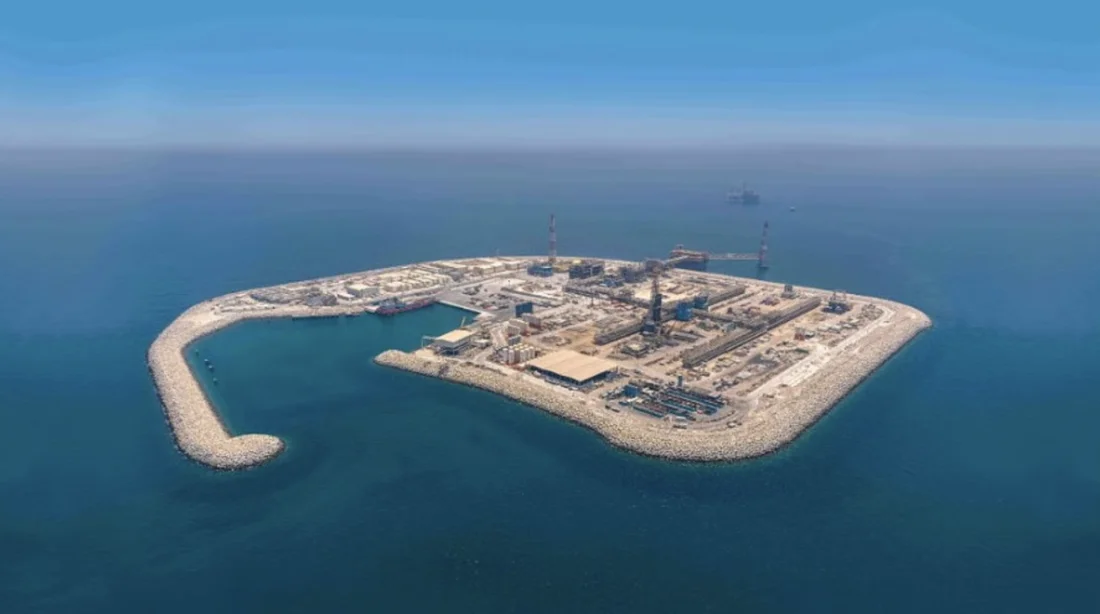
ADNOC Gas, the liquefied natural gas (LNG) subsidiary of ADNOC, Abu Dhabi's state oil company, disclosed to the Abu Dhabi Securities Exchange (ADX) on Monday that it has implemented "temporary operational adjustments" to its LNG and export liquids production following navigation disruptions in the Strait of Hormuz.
The company did not quantify the volume of the reductions. It confirmed it is managing delivery commitments on a contract-by-contract basis with its customers.
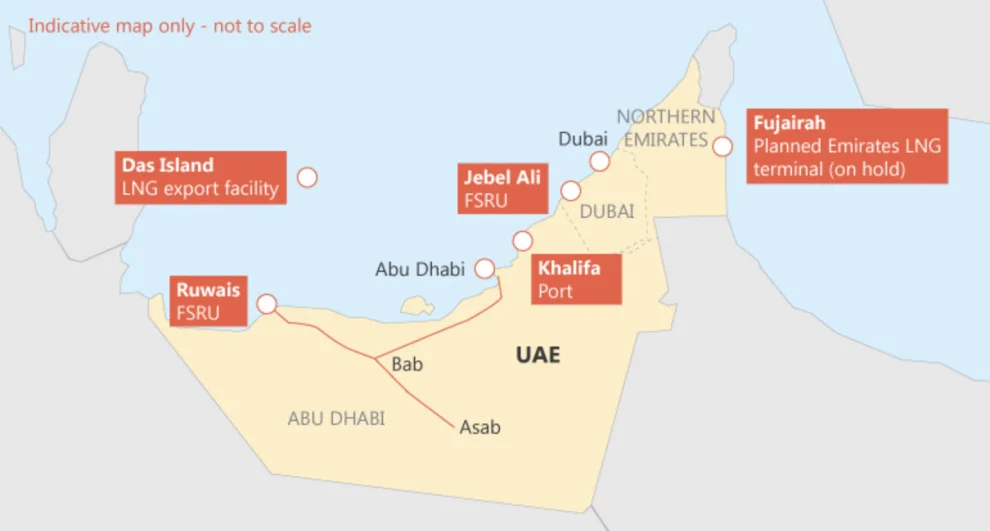
The affected installation is Das Island: ADNOC Gas's 6 MTPA LNG facility inside the Persian Gulf. Every LNG tanker departing Das Island toward a receiving market must transit the Strait of Hormuz — there is no alternative route. The Strait, which under normal conditions handles around 20% of global seaborne oil and gas trade, has been operating under severe restrictions since the United States and Israel launched military operations against Iran in late February.
The physical installations sustained no structural damage. Debris from a successfully intercepted missile landed near some plant units, but inspections confirmed no injuries and no impact to core process integrity. The Habshan gas processing complex — one of the world's largest, with a capacity of 6.1 Bcf/d — was shut down on March 19 following two such interception events and has since resumed operations. The Das Island constraint is not technical: it is logistical. The molecules are ready; the tankers cannot leave.
Monday's disclosure does not occur in isolation. Three weeks earlier, Iranian missile strikes on Ras Laffan Industrial City, Qatar's main LNG and petrochemical export hub, damaged liquefaction trains 4 and 6 at QatarEnergy, Qatar's state energy company — a combined capacity of 12.8 MTPA, equivalent to 17% of Qatar's total export capacity. Before the conflict, Qatar was the world's second-largest LNG exporter, accounting for approximately 20% of global production, according to Kpler, the energy data and analytics firm.
QatarEnergy estimated repairs will take three to five years, at an annual revenue loss of approximately $20 billion. Saad Sherida Al-Kaabi, QatarEnergy's president and chief executive and Qatar's Minister of Energy, signaled the company would be compelled to declare force majeure on long-term supply contracts with buyers in China, South Korea, Italy, and Belgium.
What Monday's disclosure changes is the scale of the problem. Both pillars of Gulf LNG are now simultaneously operating under constraints: Qatar with its liquefaction infrastructure damaged; ADNOC forced to cut output because its tankers cannot clear the Strait.
Following the Ras Laffan strike, Brent rose more than 7% to above $111 per barrel, while European and Asian gas prices moved sharply higher as the market abandoned the supply-surplus scenario analysts had projected for 2026 and 2027. Tom Marzec-Manser, head of European gas and LNG at Wood Mackenzie, the energy research and consultancy firm, told Middle East Eye that unlike oil, LNG has no global redundancy: every operational plant is already running at full capacity. With no spare volume to reallocate, supply losses translate directly into demand destruction.
The structural response is under construction. ADNOC's Ruwais LNG project — a 9.6 MTPA facility located at Al Ruwais Industrial City on the Persian Gulf coast, scheduled to come online in 2028 — will more than double the company's LNG production capacity. It will not bypass the Strait. Like Das Island, it will depend on Hormuz. It is not yet operational.
Das Island is. And it is trapped.